SURRENDERED!
This website brought to you in part by the following sponsor:

Find out how to advertise here - Email us! [email protected]

SURRENDERED!
This website brought to you in part by the following sponsor:
Twenty Years of Outlawry and Crime, the Notorious Train Robber
FRANK JAMES, SURRENDERS
The Notorious Outlaw Delivered to the Marshal of Jackson County,
WITH TEARS IN HIS EYES,
He Greets His Mother, Wife and Child, Upon His Arrival at Independence.
“YOU DIDN’T EXPECT ME,”
Was His First Expression to Officers Who Have Long Hunted Him.
THE LAST OF THE LOT.
Special Dispatch to the Kansas City Journal
ST. LOUIS, Mo., Oct. 5.- A Globe Democrat special from Jefferson City says: After the passage of the letters between the noted outlaw and the executive, Frank James, by the advice of his friends, decided to surrender, and he put his nerve and his courage to the test of setting out last night for Jefferson City alone to deliver himself to the executive of the state.
When he reached Sedalia he was joined by Maj. John N. Edwards, and the two arrived in this city about 3 o’clock this morning and put up at the McCarty house. He remained during the day, appearing in the dining room with the guests of the house, and Mr. McCarty and family, all of whom were entirely unconscious of his identity and character.
THE SURRENDER.
It having become known throughout the capitol building shortly before 5 o’clock that Frank James would at that hour put in an appearance and surrender himself, the heads of the departments and their clerks with others, who were in and about the building assembled in the executive office to await the arrival of the noted outlaw.
AMONG THOSE PRESENT
besides the governor, were Judge Henry, of the supreme court; Phil. E. Chappell, state treasurer; John Walker, state auditor; Adjutant Gen. Waddill; Mayor D.0. Fowler, and others, besides the representatives of the press. The hands of the clock on the south wall of the office were close upon the hour of 5 when the expectant ears of those present heard the
SOUND OF FOOTSTEPS
enter the rotunda of the building. A moment later the well known form of Maj. John N. Edwards appeared in the open doorway. As he advanced into the room he was followed by a man nearly six feet in height, of slender, neat and trim build, who walked erect and with a quiet, easy and self possessed gait to the middle of the room. Stopping in front of the Governor Maj. Edwards said; “Governor and gentlemen,
THIS IS FRANK JAMES.
He is here to give himself up.”
This brief introduction brought face to face the executive of Missouri and the noted outlaw whose name has been a terror in the state, and is familiar throughout our land, if not the whole world.” It was a scene of
INTENSE DRAMATIC INTEREST
and one entirely without precedent. By a dexterous movement Frank unbuckled a belt to which were attached his arms, and presenting them to the governor, said:
“Governor, here are my arms, unloaded. They have not been out of my possession since 1864. I now present them to you and deliver myself up to you to do as you see fit.’
The governor accepted the charge, saying he was glad to meet him, especially in that way. Some further conversation ensued as to Frank’s past life, but the principal event of the day was concluded.
Frank will leave Jefferson City tomorrow for Independence where his trial will take place.
FRANK JAMES SURRENDERS.
Louts, Oct. 5. — Frank James, the notorious train and bank robber, accompanied by Maj. John N. Edwards, of the Sedalia Dispatch, called on Governor Crittenden, at Jefferson City today and formally surrendered himself.
The Anzeiger has a special from Jefferson City which says when Frank James surrendered to Governor Crittenden he handed him his pistols and stated that he (the governor) was the only man, except himself, who had touched them for twenty years. Frank was at the McCarthy house this evening, and many prominent citizens were there seeking the honor of shaking hands with him.
FRANK JAMES’ LETTER.
When and where the following letter was written the bandit declined, yesterday, to state. In it, Frank claims, is every statement that, for the present, will he give to the public:
ST. Louis, Sept. 30.- -To Hon. T.T. Crittenden, Governor — Your Excellency: Time has demonstrated that however carefully I may follow the path of good citizenship, and however successful be in gaining the confidence and respect of may those who associate with me daily and hourly in every act, the work of heaping infamy on the name which my children are to bear, goes steadily on and on, as it began so many years ago. The greater the crime which startles the people of our Western states, the greater the certainty that it will be attributed to my act or instigation. However strange it may seem that a man of the reputation bear should assume to possess either or sensibility, I have the hardihood to lay claim to some degree of both. For years the one desire of my life has been to regain the citizenship which I lost in the dark days when, in Western Missouri every man’s hand was against his neighbor, and to have an opportunity of proving, by submission to the most rigorous test, that am not unworthy of such citizenship. It would avail me nothing at this day to revert to the circumstances attending outlawry, which I and thousands of others my regarded as extenuating. Those who were where they could the events in the little pages of history need no recapitulation from the me; and those who had no personal knowledge in the premises have been so stirred against me by reports of my evil doings that they would naturally give no consideration to facts of that character. The people at large reason logically that where there’s so much smoke the there must be fire, that although some of the charges against me may be unjust, all are not without foundation, and that an evasion of the officers of the law is not the course of an innocent man. My I bow to their logic and reply that the man who is now making of this making this appeal does not do so from the standpoint representatives a martyr. He comes to you with their representatives to say that though his suffering has been a hundred fold greater than they have any knowledge which he of, immeasurably greater than the course which he evaded would have attached to his acts, he recognizes that he has no right to complain of his lot. He comes as a man who, conscious of an honest purpose, asks to be permitted to do what our lowest law abiding citizen may to remove from Missouri the odium for which, he is responsible. He comes as a man, outlaw though he has been, has innocent ones who call him father and husband, and who possess love as strong and devoted as was ever in men whose lives are blameless before the world, and one who is anxious to remove from their closet the skeleton which has so long been its hideous occupant. If it were not for the fear of responsibility for that which I did not do, rather than for that which I did, Governor Crittenden, you should never have to put a price upon my head; but an excited and justly indignant public is not discriminate, and when a man is stripped of the safeguard of that presumptive innocence, with which the law theoretically surrounds him, as I would be, he is put to the dangerous necessity of proving a negative. That fear is still with me, and as I write it prompts me to abandon my present purposes, and having for nearly twenty years proved my ability to evade any attempt to capture me, to take my little family and go to some remote section, where I can live a quiet life, free from apprehension. That I refuse to obey such an impulse: that I prefer to go back to my boyhood home and face my disgrace, in order to live it down; that Tam willing to place myself under a surveillance to which no man in Missouri has ever yet been subjected, as must naturally be the case should I return: that I choose this rough course when smoother ones offer; I humbly submit as proof that I am not as bad as has been painted, and that the elements of manhood have not been omitted from my nature. Right terribly, Governor Crittenden, have the offenses against society which have been charged against the James family been avenged. God knows, enough blood has been spilled, enough hearts, broken, enough lives blighted, God knows it is the purpose the law to prevent crime by making its punishment awful to contemplate, that purpose has been served in a large degree in the ten years of terror aid tragedy. Is demand for vengeance insatiable? Justice tempered with mercy, mere poetical nothing? Must the great state of Missouri indulge spirit of revenge until it has secured its last ounce flesh; or, laying all considerations of mercy aside, cannot vour state (I would to God I could say “my state”) better afford now, that it has vindicated its laws as no state ever did before, say to its supplicants: “Yes, come in; we will convert your notoriety into a: powerful instrument of good order: we will, purely as an unsentimental investment; restore your to citizenship and give you air opportunity to prove your contrition and further your purpose; we will call upon you to utilize your experience and knowledge of wrongdoing in the enforcement of laws which you have in the past been charged with violating: you have won the confidence of all who now condemn you: we will point to it all as a proof of our wisdom. It were certain that I would not he made a scapegoat I would never have troubled you with this petitions but would have long ago faced your courts and met your have charges, had but being once in the tolls, would to accept all the chances, and, where none would have been interested in my innocence of whatever might be alleged, many might find to their advantage to assist in convicting me. Put yourself in my place for one moment and then judge of my course in keeping out of the law’s clutches. There is no other consideration other than already mentioned which has weighed heavier in favor of my taking my present step. For five months I have been in constant dread that some rash friend of mine or Jesse’s, or some silly person, seeking notoriety, might carry out the threats of assassination which have been, according to published reports, poured in upon you. Suppose for one moment that that had occurred; is there a man living who would not have held me responsible for it? And yet not only were the threats not a crime, as you will discover by comparing them with my writing; but the thought of revenge was never for one moment entertained by me. I have now stated my case, and have, I trust, avoided any savor of mawkishness. I ask if you cannot consistently with your duty give me some hope for amnesty under the conditions I have specified?
It may strike you that modesty is not the most prominent characteristic of this request; but it should be remembered that it comes from a nan who is still at large, and the uncertainty of whose whereabouts is unknown, although it need not be the cause of a deal of apprehension. I do not appeal as a man who, having followed the wrong course until his head is whitening, and he is tottering on the verge of the grave, is taught repentance by his incapacity for further iniquity; but as one who is yet young and vigorous, and who has reasonable ground to believe that there are many more years yet left him for active service within the pale of society than those which he has spent outside of it.
I submit that it is not an improper question for your consideration, whether it would not be better to have Frank James a hunter of fugitives than a fugitive? Whether Frank James, humbled, repentant and reformed, before all the world, will not bear example more fraught with good to the rising generation than Frank James, a mysterious wanderer, or the occupant of a felon’s cell or grave. The appeal, though anomalous and possibly without a complete precedent, is not the result of a sudden whim, but is born of a determination which has been forming for years, and which has already stood the test of four years sober industrious farm life, as I will have no difficulty in satisfying you. I am prouder of the nerve which has enabled me to take this step in behalf of my better nature, than any courageous act of all my life. I write this letter from St. Louis, and leave it here to be mailed. An answer addressed in care of my wife, at Independence, Mo., will reach me, and I will not say how fervently I pray that it will not be the answer of a Nemesis. Yours, contritely and hopefully.
[Signed] FRANK JAMES.
THE CORRESPONDENCE.
SEDALIA, Oct. 5. — Frank James has written a letter to Governor Crittenden asking amnesty. It says in substance that he is anxious to be restored to citizenship; that he wants to put the past behind him; that he is heartily sick of the life of an outlaw; that he has a wife and child to plead for him and make him human, though he were as bad as he has been described; and he throws himself upon the mercy of the governor and asks that he be saved.
In reply, Governor Crittenden writes to him as follows:
STATE OF MISSOURI,
EXECUTIVE DEPARTMUNT, CITY OF JEFFERSON, October 2, 1882.
Frank James.
SIR — Your letter dated St. Louis, October 1, 1882, has been received, in which you “apply me for an amnesty or a pardon under the constitution of this state.” I cannot grant a pardon, even if inclined to, before conviction of some crime. Whether you can be convicted of any violation of the law, it is not for me to say; that the courts of the state will determine in the proper way, when you are before it. I think it wise in you to abandon the life you are charged with leading, and in surrendering to the legal authorities of the state, or the county in which you are located. If innocent of those charges, then you will have an opportunity to prove it to the world. If guilty, the law declares the punishment. If you surrender, you, as any other man charged with crime, shall and will have a fair and impartial trial. The intelligence and character of the courts of this state are ample guarantees of such a trial, without any assurance from me. One not based upon nor governed by the prejudice or the sympathy of the people, but under the judicial forms of just and well established laws. As determined as am to see the laws enforced against all grades of crime, I am none the less convinced of the importance to society of having every man within the grasp of the law protected in his rights, however lawless he may have been, when he yields voluntarily and submissively to the law, and appeals to it, and to me, for justice and mercy. You may be innocent, or you may be guilty of all the various crimes charged to you. That the courts will determine, as before said; and after the voice of the court is heard, then, if it becomes necessary, I will decide what my actions shall be. Yours truly,
THOMAS T. CRITTENDEN.
[From the Journal of Saturday, October 7.]
Last night the most noted criminal in America, Frank James, was confined perhaps for the first time in his life as a prisoner, in a prison cell. His bed was a single mattress spread upon the floor of the apartment he occupied. The change was indeed great, yet one that he voluntarily brought upon himself. A sight of the noted outlaw was interesting. He is to all outward appearance an invalid, a man that seemingly does not possess the strength of a child, yet thousands there are who have feared him, and who have known him as the greatest criminal in America. Rinaldo Rinaldino, the Sicilian robber, long ago, terrified the people by his bold outlawry. His execution paid the penalty of his crime. Robin Hood and Dick Turpin terrorized England with their bold deeds. Cartonche, the Parisian robber, was executed for his crimes. In our own country a robber that a half a century ago plied his calling on grounds since visited by the criminal now confined, was executed. John A. Murrell though not entering business centers, and robbing banks of their wealth, and stopping railroad trains as if they were playthings manipulated by children, brought dread upon Kentucky by his robberies of men upon the highways, and murdering in cold blood his victims. As heartless was he as have been the Missouri outlaws. On one occasion traveler accosted him as the two were riding in Kentucky. The stranger, a criminal like himself, said that he was in possession of a considerable sum of money, and desired that the two engage in a gambling scheme. Getting down from his horse to get a drink from a spring, Murrell shot him dead. Upon search, he found that the stranger had no money, whereupon he said: “A man that would lie about his money deserves to be killed,” of charges are true, like Murrell, has been Frank James. Ho has robbed and he has killed. A ransom of $15,000 has been offered for his body dead or alive. Man’s insatiable desire for money has induced persons to seek him whose capture would amply reward them. They have looked tor him day and night, being hunted like an animal. Indeed his appearance is that of the animal that for hours eluded the huntsman, but at last fagged and from its endeavors to escape stands to be made the victim of the marksman’s bullet. James states that his daily life has become miserable. He has known'” no home. Today be is here; tomorrow there. His life has been in the saddle, a revolver his companion. Footsteps, crackling twigs, or rustling leaves have brought terror to him, Dreaming of the peace and happiness of a home, of a wife’s love and child’s affection at the fireside, he has resolved to return to the state that for twenty-one years has looked upon him as the greatest of criminals, and as he says establish a home and try and regain the respect of the people. It is one of the greatest of sinners seeking forgiveness from those ho has wronged. He claims to be innocent of the crimes with which ho is charged. The courts alone will tell him whether or not he is guilty, Governor Crittenden has told him that he will be treated as a criminal and he consents.
There are a number of indictments against James. He is charged with murder in the first degree, and robbery. Officials believe that they have evidence sufficient to convict him. Whether his sentence will be lighter than is customary in such cases, remains to be seen. On the charges preferred he will be tried in this city at the November term of the criminal court, and until then he will remain confined either in the jail in this city or at Independence.
AT INDEPENDENCE.
Thursday night the bandit, in charge of F.C. Farr, private secretary to Governor Crittenden, and accompanied by Maj. J.N. Edwards, left Jefferson City for Independence and arrived “in the latter place yesterday morning about 10 o’clock, the train being two hours late. At stations passed during daylight much interest was manifested, and depot platforms were crowded with expectant people, men, women and children. As the train swept through the timbered country, James spent most of his time looking out of the windows. Pointing toward the wooded hills and thicket-grown pastures, he remarked, “That’s a mighty good bushwhacking country; I know every foot of that ground, Many a time have I watched from those hills and seen the soldiers pass up and down.” A passenger pretended to recognize James, and going to him called the latter’s name and gave his own. “I don’t know you,” responded James. “I don’t often forget faces, and I know I have never seen you.” Thereupon he turned and renewed his observations through the window.
The announcement in the JOURNAL yesterday morning that Frank James had surrendered, was received with great surprise, and it was the occasion of drawing a large number of people from city and country to Independence, where it was stated the bandit would arrive. On the early trains leaving this city a number of people left for Independence, among them being officials who had been notified by the governor to be present and receive the prisoner. From the country, on foot, on horseback, and in conveyances, came those who for years have known Frank James as the bandit. All desired to get a glimpse, if nothing more, of the noted individual. When the train arrived the depot was crowded.
Marshal Murphy, Attorney Wallace in lavender pants, Commissioner Craig and Capt. Ditsch, of this city, and Sheriff Timberlake, of Clay county, formed a group who arrived early at the depot, Mrs. Samuels arrived in Independence Thursday night, and together with Mrs. Frank James, Rob James, son of Frank, Miss Maggie Ralston and Mr. Sam Ralston, were there to meet their relative. In looking upon the throng a number of those who had been and now are personal friends of Frank were seen.
The train, a long one, slowed up, stopped and all eves were turned towards the car from which James alighted. The private secretary of the governor was the first to step upon the platform. The outlaw followed. Immediately he was seized by his mother. She, as usual, began crying. The outlaw, too, wept. Leaving his mother, Frank embraced his wife. She, to use the words of another, was “as happy as Emma Abbott.” James next pressed to his breast his little boy, a bright looking child, about 4 years of age. The crowd eagerly watched his actions. As those present looked at him some exclaimed: “I thought Frank was a fine looking man.’ Others said: “How thin he looks; he looks as though he has suffered greatly.”
Those of Frank’s friends who had been associated with him during the war scarce knew him, he was so changed. Mr. Pres Webb, living east of Independence, readily recognized him, and was in turn recognized by Frank.
Others of his friends introduced themselves, and the memory of some of them was recalled, and of others not. Frank, his relatives, Marshal Murphy and Capt. Ditsch, entered a bus and were driven to the Merchants’ hotel. Along the route, the outlaw would occasionally recognize a person, and would astonish him by calling out his name. Arriving at the hotel, the party went directly to a room on the second floor. In the hotel and on the sidewalk in front, a great crowd had gathered, of the curious inclined, but none were permitted to enter the room which contained the man that all wanted to look upon. Some time was occupied in consultation. The question of giving Frank his liberty on bail was agitated, and again was the placing him in jail considered. During this consultation Frank requested that no one aside from those immediately interested in his case, be allowed to enter the room, and his request was complied with. Shortly before the dinner hour, James was placed in charge of Marshal Murphy by Mr. Farr, who, approaching the marshal, said: “I surrender Frank James to you. He is now your prisoner.” The prisoner said nothing. Outsiders were then permitted to see the show. A number of officers, together with members of the press, gathered in the hallway of the second floor of the building, and the man of whom all had heard, was brought from his room and introduced. There were Commissioner Craig, Sheriff Timberlake, and many others, all of whom acknowledged the introduction in a manner becoming a Chesterfield. They grasped his hand, readily extended to them, and called him “Mr. James.” “You didn’t expect to see me here?” was the greeting he offered the lookers on. “Well, I’m not as bad a looking man as you thought I was, and he smiled and laughed. No one offered a response. Then an excellent opportunity was offered to note the appearance of the man. As all officers present stated, the description that has been given of him, was not one that would ever lend to his detection. He looks like an invalid. In height he is five feet and nine inches. He is of spare build, with rather prominent cheek bones, large and straight nose, blue eyes, and retreating forehead. His complexion is that of a man who has been for some time in confinement. He has a small blonde mustache, and hair somewhat dark. A portion of his head is bald, and is pointed and high behind. His ears, which have been reported as extended, lie close to his head. His manner is quiet, and his language is that of an educated man. His dress was unobtrusive, the only jewelry being a gold watch and chain. His talk, in expressive but intelligent language, was “jerky.” Called aside for a moment, from the crowd that observed him, he walked the length of the hall, and then returned. He seated himself on a stair railing, and was approached by a JOURNAL representative. Some pointed queries were propounded, in the answering of which James showed signs of nervousness, yet began to reply to them. Before he had finished his remarks, however, Sheriff Timberlake grew envious, and called James away. Murphy showed his authority and called the prisoner away, requesting that he enter the room once more. He obeyed. The door closed and once more Frank was in the hands of his relatives. The marshal invited Commissioner Craig to enter the room. The latter at first refused, but finally doffed his hat and went into the presence of Mrs. Samuels and her son. He was politely received, being recognized by the mother, son and wife. Dinner was not taken until after the crowd had eaten. The party at the table was composed of the criminal, wife and child and mother, Mr. and Mrs. Ralston, Miss Ralston and Marshal Murphy.
After dinner the party again returned to the same room previously occupied. A little later the marshal informed his prisoner that he must go to jail, The announcement seemed to surprise James, and he asked to be permitted to give bail, saying he could give any amount required. The request was not granted. Again Mrs. Samuels wept, and threw her arms about the neck of her son. He kissed her, kissed his wife and child, and was taken to jail. A few old acquaintances called upon him and talked of times past.
His cell is on the second floor of the jail, an apartment about 9×12 feet in size, and provided with a mattress for a bed, and a single chair. In the cell is but one window, and that looking directly out upon a wall not five feet distant. The apartment is perfectly white, having but a short time since been thoroughly whitewashed. On the doorway leading in to the prison department of the jail, someone yesterday scratched in large letters, the name “Frank James.”
The criminal will be brought to this city, but at what time the marshal, yesterday afternoon, was not certain. It is probable that he may be brought to Kansas City today.
His trial on the charges preferred against him will take place at the November term of court in this city.
George James, the half witted fellow who is seen about the streets of the city almost daily, and who is a cousin of the outlaw, sought an interview with his relative. Frank saw him, and said: “You are the ugliest devil I ever saw.” George claimed that be was very anxious that his cousin should pay him money which had been borrowed from him.
Messes, Edwards and Payne were on the streets at Independence yesterday, but did not furnish the press with an item.
In Frank’s head are two indentations. These formed one of the marks by which Liddil claimed he could identify him.
James has been shot seventeen times, three times in the mouth. There is a slight scar on the lower lip, which is almost hidden by a mustache, and he is minus eight or nine teeth. He can to-day, he says, ride further and faster, and do with less food and sleep than any other man in Missouri.
Parties who saw Jesse James, and saw Frank yesterday say there is no resemblance between the two.
A TALK WITH THE CRIMINAL.
In the corridor of the Independence jail, Frank James was met yesterday afternoon by a JOURNAL representative. When the reporter entered the prisoner was seated on a window sill, busily engaged in talking with an old acquaintance. He seemed happy and talked freely, though not upon subjects which related closely to his criminal career.
“And you have at last surrendered?” said the reporter, after being introduced to James by Marshal Murphy, “What influenced you to take this step?”
“I was tired of an outlaw’s life,” replied James. I have been hunted for twenty-one years. I have literally lived in the saddle. I have never known a day of perfect peace. When I slept it was literally in the midst of an arsenal. If I heard dogs bark more fiercely than usual, or the feet of horses in a greater volume of sound than usual, I stood to my arms. Have you any idea of what a man must endure who leads such a life? No, you cannot. No one can unless he lives it for himself. I have thought of this move for a long time. I have thought of my wife and child, and have wanted to settle down where I could be with them, and unmolested could enjoy the comforts of life. Soon after I became an outlaw, I wanted to change and become a reputable citizen. I had no chance. Men hunted me, governors of this state have looked for me, but with the exception of Governor Crittenden, they wanted gain and fame. Governor Crittenden has hunted to vindicate the law and drive out train and bank robbers from the state.”
“Has Governor Crittenden made you any promises?”
“None. You have read his letter in reply to mine, and except what that contains, he has never said another word, I do not want him to make me any promises. Wait until the courts decide whether I am guilty or not guilty. I do not deny that I want one single chance to prove that my surrender is in good faith, and that I can become once more a good citizen. Governor Crittenden can afford to give me that chance. He has already dove what bus never been done before in this state, he has made highway robbery impossible. If I am allowed the same trial that is accorded any criminal, I feel that I will be vindicated of every charge, I have confidence in Governor Crittenden, for if I had not I would not be here to-day.”
“Where have you been the past few years?”
“During the past ten years I have been but a little time in Missouri. For four years prior to ’81 I was on a farm, living as a respectable farmer, seven miles from Nashville, Tenn. That I stood well in the community, I can prove by many of the most prominent men in Nashville, but I was so hunted that it became necessary for me to leave that place.”
“And where did you go then?”
“I hid myself as you know. I was in various places, spending part of the time east of the Alleghenies. The best place for a man to hide is in the large cities, and then to say little and be his own confidant.”
“Where were you at the time of Jesse’s death?”
“East of the Alleghenies. I saw the announcement 011 the morning of the 4th of April in the New York Herald.”
James was in Alexandria that morning, so an officer stated yesterday.
“How long since you were in Kansas City?”
“More than a year.”
“Mrs. Jesse James has stated that you were concealed in a garret at her house, after the Blue Cut robbery?”
“I think she is mistaken,” replied the interrogated party, hesitatingly. Continuing he said: “No, I was not there.”
“What kind of weapons did you present to Governor Crittenden?”
“I gave him a belt and a Remington revolver, caliber 44, and forty-two cartridges, and when I handed it to him I told him that for the first time in twenty-one years, I permitted another man to take my pistol. It was the happiest moment of my life, and I felt freer and braver than I had since 1861. The belt was captured in open fight at Centralia, and the revolver after its owner had shot me through and through, was taken from him before I fell.”
“Have you had any picture taken of yourself recently?”
“Not since 1863. That portrait of mine in Edwards’ ‘Noted Guerillas’ was taken from that picture. If you have ever seen it, you will admit that I have changed greatly since then.”
“You spoke of concealing yourself for more than a year, or since, ’81, what did you do to pass the time?”
“Oh, you know a men can make money playing poker. I did that sometimes, then read a good deal. I read the Bible, Shakespeare and Plutarch’s lives,” and James began quoting passages from Shakespeare with the readiness of a college professor in the belles lettros chair. “By the way,” continued the outlaw, “I was Col. Van Horn’s ‘devil’ in 1857. He was then editor of the Kansas City Enterprise, a paper owned by D.K. Abeel; it was Democratic. I didn’t like the business, however, and so left it. Now, that’s something that no body has got on to, and you can publish it for the first time.”
“Who are to be your attorneys?”
“That is not settled yet. I want to obtain the services of Col. Philips and C.P. Johnson.”
“What do you propose to do if you are permitted to return to your home?”
“Farming is my legitimate occupation, and as soon as I can get affairs settled, if that can ever be done, I will engage in it.”
“How are you fixed financially?”
“I am almost entirely without means, and if I am allowed to return to farming I will be able to equip a small farm in only a very humble way.”
“Where will you locate?”
“That I have not determined. There is so much to occur before I can come to the consideration of that question that I have not given it more than a thought. Of course my preference would be for the region in which my old home was situated.”
“What was Jesse’s occupation?”
“He was a great patron and lover of the race track, and spent much of his time there. He had several fine horses, and among them was the famous Jim Malone which won a big race not long ago in St. Louis, a four mile race at Louisville and a cup at Atlanta, Ga. The horse had not made much of a record, however, at the time Jess sold him to a druggist in Nashville named John Greener. Jess moved around with perfect freedom there.’
“Was Jesse as plucky as he was credited with being?”
“He was the gamest man I ever knew, and the only man that ever questioned his courage was Bob Ford — after he was dead. If Bob doubted his courage, it was a little curious that he and Charlie should wait for months to get him with his pistols off, and should then shoot him in the back.”
Referring to his career at Nashville, James said at one time he exhibited and took the prize fox Poland-China hogs at the Nashville and Jackson fairs, and that he had entered his horse, Jewel Maxey, for the gents’ riding stakes at Nashville, two consecutive years, and had won the first prize the first time and second prize the second year. He rode himself the second time. He claimed that no one knew his identity except the members of his own household and members of Jesse’s family. His little boy was born near Nashville.
Frank’s wife read to him the account of the killing of his brother by Bob Ford. Jesse it seems, from the bandit’s story, never trusted Bob, but suspected him of treachery. Charlie Ford he thought a great deal of. Frank is of the opinion that Charlie was not in the plan to assassinate Jesse. In speaking of Governor Crittenden, James referred to a previous interview in which he said: “I don’t blame Governor Crittenden for the part ho had in that affair. I am satisfied that there was no contract for assassination; and if I were a governor, charged with upholding the laws of a great state cursed by such a band of robbers as had terrorized Missouri, I would take desperate measures to meet such desperate men. They would have to go, as in this case they have gone. Such is the fate of all such bands. But what must be the suffering that poor, pitiful of creature, Bob Ford! For the sake few paltry dollars has, while on the verge of manhood, brought, upon himself a blighting curse that will never leave him the years to come, and that will, even after he is dead affix itself to all that’s left of him his name. Why, did you notice how soon remorse seized upon him after he had won blood money? He was rushing away from his victim with all the horrors of Macbeth when the poor, desolate little wife called to him and begged him come back. What did ho nay? ‘I swear to God I did not do it!” Again, like Macbeth, “I’ll go no more. I’m afraid to think what I have done. Look upon it again I dare not.’ Watch him again New York. He is certain he saw the face wife there, while as a matter of fact my wife was at her father’s house in Missouri. His imagination has already begun to do terrible work, and he blood and horror wherever he looks. Is his experience different from that of any other traitor since the olden epoch of 2,000 years before Christ? They said, as they said many another idle thing, that I had sworn vengeance against the assassin, and that I would have a life for a life. Would that vengeance? Would it be vengeance to shorten the life which is an agonizing torture to him? Would vengeance to send home corpse to break the heart of the mother who loves him as mine loves me? Would be vengeance to come home to my wife and mother and show them the red brand of the murderer? No. When I took the paper and read the account that morning, my wife and I sat down and talked about it. I said then that the air would be full of rumors to what I would do, and I proposed to do nothing. I had never made a threat in my life against any man (and this you can substantiate if you will accent the statement those who knew me) and I was not going to begin now.”
INDICTMENTS.
The outlaw will be compelled to stand trial on the charge of murder and robbery. He is charged with aiding in the killing of W. Wicher, one of Pinkerton’s detectives in 1874. Wicher was trying to work up a case against the outlaw, and visited Clay county. Through some means it became known that the was a detective, and the members of the James family were notified. The detective applied for work as a laborer at the home of Mrs. Samuels. When he did so he was taken, it is thought, by the James boys, placed on a horse, and led into Jackson county. Away from habitation and unable to defend himself was shot from the horse upon which he rode, the bullet passing through his head and killing him instantly. His body was left in the road and on it was pinned a card containing the words: “This is the fate of detectives.”
Frank is also charged with the murder of the Winston train robbery; also for participating in that robbery, and in that at Blue Cut, and for a bank robbery.
United States of America, Western division of the Western district of Missouri, S.S. In the United States district court, for the Western division of the Western district of Missouri, May term, A.D., 1882.
Be it remembered that William Warner, district attorney for the United States of America, for said district, who prosecutes for the said United States, in this behalf, in his own proper person, comes into said court before the Hon. Arnold Krekel, the judge of said court, at the City of Kansas, on the first day of said term, and for the said United States, gives the court here to understand and to be informed, that on the 1st day of September, A. D., 1882, at the said division and district of Missouri, Frank James, Richard Liddil, et al., did then and there, knowingly, willfully and unlawfully, obstruct and retard the mail and a certain carrier carrying the same, contrary to the form of the statute in such case made and provided and against the peace and dignity of the United States. Whereupon the said district prays upon behalf of the said United States the consideration of the court here in the premises and that due process of law may be awarded against them, the said Frank James, Richard Liddil, et al., in this behalf to make their answer to the said United States touching and concerning the premises aforesaid.
WM. WARNER,
United States Attorney,
Filed May 25, 1882.
CAPIAS.
STATE OF MISSOURI, COUNTY OF JACKSON,
The State of Missouri to the Marshal of Jackson County and State aforesaid, Greeting:
We command you that you take Frank James and him safely keep; that you have his body before the judge of the criminal court of Jackson county, at the court house in Kansas City, 24th of May, 1880, then and there to answer unto the state of Missouri an indictment against him, preferred by the grand jury for the body of the county of Jackson for robbery in the first degree, contrary to the statutes made and provided. Hereof fall not at your peril, and have you then and there this writ.
Witness. John T. Wilson, clerk of the criminal court of Jackson county, with the seal thereof hereto affixed, at office in Kansas City, this 7th day of May, A.D. 1880. JOHN I. WILSON, Clerk.
Executed this writ in the county of Jackson and state of Missouri, on this 19th day of November, 1880, by making diligent search for the defendant, and he cannot be found. JAMES W. LIGGETT, County Marshal.
Indictment. State of Missouri, county of Jackson, In the criminal court of Jackson county. Mo., at Kansas City, Mo.. November term. A.D. 1879.
The grand jurors for the state of Missouri, in and for the body of the county of Jackson, upon their oath present that Frank James, Jesse James, Dora Fox, et al., late of the county aforesaid, on the 10th day of March, 1874, at the county of Jackson, state of Missouri, in and upon one Joseph W. Wicher, then and there being willfully, feloniously, deliberately, premeditatedly and of their malice aforethought an assault did make; and the same Frank James el al, each then and there having and holding in his right hand a pistol, loaded and charged with gunpowder and leaden balls — the said pistols did then and there willfully, feloniously, deliberately, premeditatedly, and of their malice aforethought shoot off and discharge upon the body of the said Jos. W. Wicher and did then and there with the leaden balls aforesaid, by means of shooting and discharging the said pistols as aforesaid, willfully, feloniously, premeditatedly and of their malice aforethought, strike, penetrate and wound him, the said Joseph W. Wicher, in and upon the body of him, the said Joseph W. Wicher, giving him of then and there, by means of shooting off’ and discharging the said pistols as aforesaid, in and upon the body of him, the said Joseph W. Wicher, divers mortal wounds, of which mortal wounds the said Joseph W. Wicher did then and there instantly die.
And so the grand jurors upon their oath aforesaid, do say and present that the said Frank James et al., him the said Joseph W. Wicher aforesaid on the day and year aforesaid, at the county and state aforesaid, in the manner aforesaid, willfully, feloniously, deliberately, premeditatedly, and of their malice forethought, did kill and murder, against the peace and dignity of the state.
JOHN L. PEAKE.
Prosecuting Attorney,
Indictment. State of Missouri, county of Jackson, in the criminal court of Jackson county, at Kansas City, Mo., November term, A.D. 1879.
The grand jurors for the state of Missouri, in and for the body of the county of Jackson, upon their oath, present that Jesse James, Frank James et al, late of the county aforesaid, on the 27th day of November, 1867, at the county of Jackson, state of Missouri, in and upon William McCoy and Isaac N. Rogers, then and there being unlawfully and feloniously an assault did make, and $3,000 in lawful money of the United States, duly and legally issued under and by virtue of the laws of the United States, of the value of $3,000, the property of the First National Bank of Independence, then and there a corporation, duly and legally incorporated, under and by virtue of the laws of the United States, in the and against the will of the said William McCoy and Isaac N. Rogers, then and there by presence force and violence to the persons of the said WilIiam McCoy and Tanne N. Rogers, feloniously did rob, steal, take and carry away; and the said Jesse James, Frank James, et al., continuously since the said 27th day of November, 1867, have, been fugitives from justice, and during said time have not been inhabitants of nor usually residents in the state of Missouri, against the peace and dignity of the state, JOHN L.
PEAKE, Prosecuting Attorney,
WILL JAMES BE CONVICTED?
Among the officers in this city the opinion (is varied as to the possibility of a conviction of Frank James for any of the long list of crimes with the commission of which he is charged. “Who is there to testify against him? queried one officer. Dick Liddil, even if he knows anything about it, won’t be very likely to appear as a witness. He has trouble enough of his own. And anyhow I do not believe he will go on the stand and give any testimony damaging to Frank. He would get himself in worse fix than he is now, and that is bad enough for him I guess. Then there are the Ford boys. Suppose they know anything against the prisoner, which I believe they do, will they be fools enough testify to the matter? I rather guess not. No, sir; I don’t believe Frank James can be convicted of a single crime which he charged with committing.”
Another official said believed that even it Frank was convicted on either the indictments against him in this county he would be pardoned the governor. Of course Crittenden couldn’t hand him a pardon or a promise in advance, he said, but reading between the lines of the governor’s letter, and knowing of his pardoning propensities, could almost see in writing there, the great seal of the and attached, pardon in for all crimes committed bandit within state Missouri and all attached, a pardon in full for all crimes committed by the bandit within the state of Missouri.
“I don’t believe Frank James would have come in,” said another, “without assurances of pardon from our governor. I believe the surrender only means a consummation of negotiations long pending.”
“You may indict almost anybody, said a semi-official, “but the difficulty is to prove the charge. You mark my word, Frank James can’t be convicted anything. Witnesses can’t be had, any or even positive use as testimony.”
Another who has given the doings of the James gang considerable professional attention, said he was not so sure about escape the from any conviction. Its bandit very fine for him to march up in grand style and in the rotunda of capitol meet the governor and staff in line, up as if on dress parade about to pass in review before him, and there almost amid the salvos of artillery, the blare brass bands, the clanging bells the plaudits of the multitudes, say with condescending air of conquering hero, “‘Governor Crittenden, I have come. You may salute me.’ This kind of business may deceive some folks into worshiping Frank James as a hero, but I am inclined to believe that rubs off and the cold facts of Frank James’ infamous crimes are held up in their proper light, a felon’s cell or possibly the gallows may rob the gallant personage of much of the grandeur now surrounding him. Take the case of the murder of poor Wicher, the adventurous Chicago detective. He was waylaid, held up, and shot by members of the James gang, and Frank was one of them. I happen to know that there lives in this county a man who ferried Frank James, Jesse James, Dora Fox, and Jim Cummings across the Missouri the night they took Wicher, bound and gagged, across the river and shot him by the roadside. This man knew the party, and I believe his testimony can convict Frank James of at least being an accessory. Then there is Albert Devers, the witness before the grand jury upon whose testimony the indictments were, brought against the gang. He lives in Daviess county, this state and can easily be subpoenaed.”
“Well, don’t you believe the governor will pardon Frank, even if convicted of any of the crimes with which he charged?”
“Possibly he may. But if Frank. James is convicted of train robbery he will run plumb up against the United States government, which will file information against him for obstructing the United States mails. Of course, this won’t deprive him of his life, but it will very materially curtail freedom, for there is no special sentimentality with Uncle Sam towards any Missouri train robber. Dick Liddil’s case is proof enough of that.’
“It may he that nothing can be made out of the information now on file in the United States district clerk’s office here against Frank James for obstructing the United States mails, but there is the Mussel’s shoals affair, and I am told there is very good evidence to show that Frank was in that little offense against United States law. Dick Liddil says he was, and the agent who was robbed, Mr. Alexander C. Smith, is positive he could identify the man who attacked him, as they wore no masks and he had plenty of time to carefully note every feature.
“No, sir. Frank James is in jail now, and though of course future developments are uncertain, yet I miss my guess if he enjoys the perfect liberty of a free man until he has run the gauntlet of a dozen trials, and perhaps served out sentences in a few state and government prisons.”
WALLACE’S STATEMENT.
Mr. Wallace, the prosecutor, expressed the profoundest surprise at having received a telegram the evening previous announcing James’ surrender. He said it came like a clap of thunder from a clear sky. He could hardly believe his eyes, and had to read it over three or four times before he could make himself believe its genuineness. He had no idea that any negotiations for the bandit’s pardon were going on at present, and did not know what to make of it. A few weeks after Jesse’s death, Frank James, it was thought, through some influential friends in this state, made overtures to Governor Crittenden in Frank’s behalf. At that time Frank is reported to have offered to came in on certain conditions, consisting of immunity from prosecution for past offenses. The stir that the mysterious maneuvers of the James family made at that time is still fresh in the public mind, as the newspapers were filled with accounts and conjectures of what was going on, and editorial comments on the wisdom of a pardon were freely indulged in. “At that time,” said Mr. Wallace, “I was opposed to any pardon, and Governor Crittenden and all other officials knew it. In some quarters there was a disposition to show clemency, but I did not join in the sentiment, and have reason to believe Governor Crittenden did not either, for he declared to me that he said to Frank ,James, ‘If you come in you must come in as any other criminal, and stand your trial for crimes committed.’ That was the only, the unalterable answer Crittenden gave, as he assured me, and as I have every reason to believe. Thus the matter stopped, and I had no idea that there were any negotiations pending for tie surrender at the present time. What it means I cannot tell, but one thing is sure: Frank James will have to stand trial on the indictments which are still outstanding against him in Jackson county.
I don’t think Governor Crittenden has changed his mind and offered Frank a pardon or given him any assurances of executive clemency, but as I say, I don’t know anything about the matter, and as it is well known that I am not in the pardoning crowd, it is possible that I have not been let into the secret of the recent negotiations.”
MRS. SAMUELS.
“Yes, I was with Frank; but I couldn’t hardly get a chance to see him, so many were around,” said Mrs. Samuels, after returning from Independence, last evening.
“How does he look?”
“Not so well as he did four years ago.”
“Do you think be will be convicted?”
“I am afraid he will be. They are bound to lay charges to his door that he is not guilty of. It seems to me that as long as he gave himself up, and might have run at large forever, they should be easy on him.”
“Haven’t I seen Frank here at the depot lately?”
“No. I think not; the last Frank was seen ground here was at Jesse’s funeral. Look here, ain’t you quizzing me? I shan’t talk any more.” And she didn’t.
MAJ. EDWARDS.
Maj. Edwards, having been so prominently connected with the surrender of Frank James, was a sort of a side attraction at Independence yesterday. In speaking of the bandit’s action, he said that he had been endeavoring to bring it about for the past two months. On last Sunday, Frank was in St. Louis. The next he came to Independence and met day his wife. Wednesday he boarded the Missouri Pacific train at Lee’s Summit, and at Sedalia was joined by the major. Together the two went to Jefferson City; what transpired there and what part was taken by Mr. Edwards, have already been published.
—————-
Kansas City Weekly Journal, October 12, 1882, Page 3. via Newspapers.com (https://www.newspapers.com/article/kansas-city-weekly-journal-1882-surren/199956466/ : accessed June 22, 2026), clip page for 1882 – Surrender by user darryl_gpc54
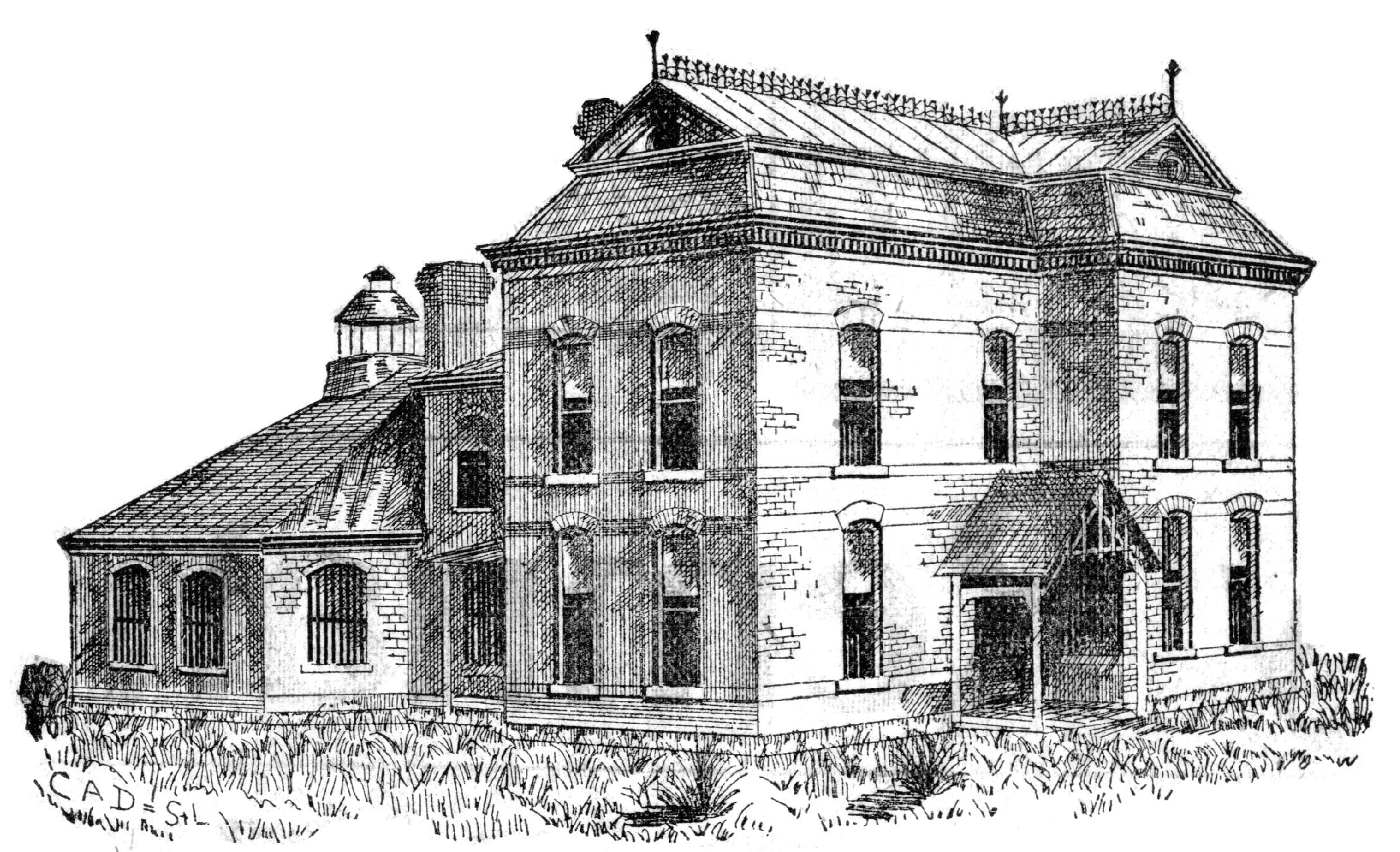
Visit the 1889 Squirrel Cage Jail, located 2 blocks west of the Daviess County Courthouse in Gallatin, MO. This historic relic is listed on the National Register of Historic Places and serves as a visitors’ center — by appointment,
Trudi Burton, ph: 660.663.7342
Search digital posts from 1999 to 2021:
GallatinNorthMissourian.com
Read the last special edition published by the Gallatin North Missourian in 2021:
Daviess County History Guide