A TALK WITH THE CRIMINAL.
This website brought to you in part by the following sponsor:

Find out how to advertise here - Email us! [email protected]
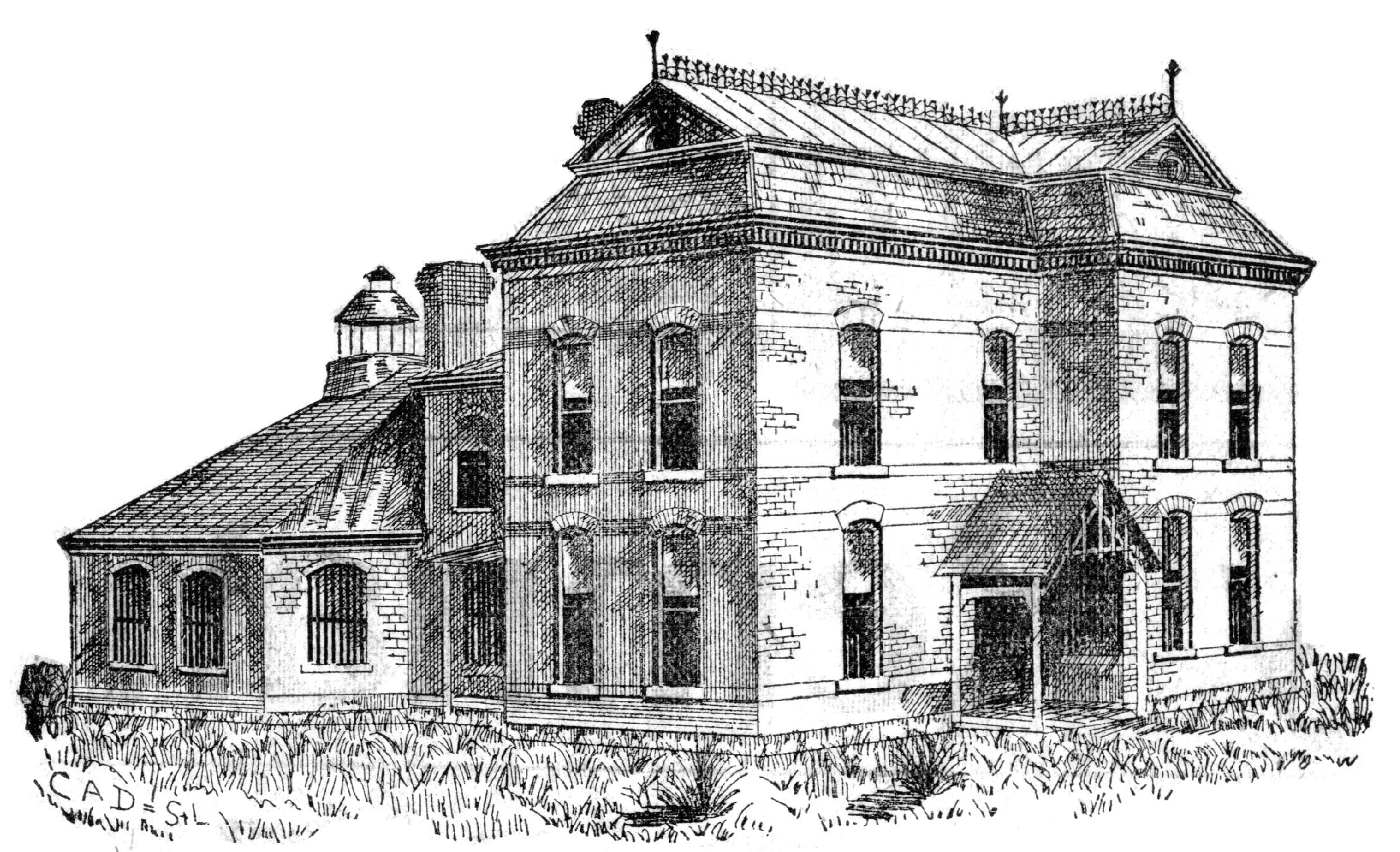
In the corridor of the Independence jail, Frank James was met yesterday afternoon by a Journal representative. When the reporter entered the prisoner was seated on a porter window sill, busily engaged in talking with old acquaintance. He seemed happy and an talked freely, though not upon subjects which related closely to his criminal career.
“And you have at last surrendered?” said the reporter, after being introduced to James by Marshal Murphy. “What influenced you to this step?”
“I was tired of an outlaw’s life,” replied James. I have been hunted for twenty-one I have literally lived in the saddle. I years. I have never known a day of perfect peace. When I slept it was literally in the midst of an arsenal. If I heard dogs bark more fiercely than usual, or the feet of horses in a greater volume of sound than usual, I stood to my arms. Have you any idea of what a man must endure who leads such a life? No, you cannot. No one can unless he lives it for himself. I have thought of this move for a long time. I have thought of my wife and child, and have wanted to settle down where I could be with them, and unmolested could enjoy the comforts of life. Soon after I became an outlaw, I wanted to change and become a reputable citizen. I had no chance. Men hunted me, governors of this state have looked for me, but with the exception of Governor Crittenden, they wanted gain and fame. Governor Crittenden has hunted to vindicate the law and drive out train and bank robbers from the state.”
“Has Governor Crittenden made you any promises?”
“None. You have read his letter in reply proposed and except I do want him what that contains, he has never said another word. I do not want him to make me any promises. Wait until the courts decide whether I am guilty or not guilty. I do not deny that I want one single chance to prove that my surrender is in good faith and that I can become once more a good citizen. Governor Crittenden can afford to give me that chance. He has already charged done what has never been done this state, he has made highway robbery impossible. If I am allowed the same trial that is accorded any criminal, I feel that I against be vindicated of every charge. I have confidence in Governor Crittenden, for if I had not I would not be here to-day.”
“Where have you been the past few years?”
“During the past ten years I have been but a little time in Missouri. For four years prior to ’81 I was on a farm, living as a respectable horse, seven miles from Nashville, Tenn. That I stood well in the community, I can prove by many of the most prominent men in Nashville, but I was so hunted that it became necessary for me to leave that place.”
“And where did you go then?”
“I hid myself as you know. I was in various places, spending part of the time east of the Alleghenies. The best place man to hide is in the large cities, and then to say little and be his own confidant.”
“Where were you at the time of Jesse’s death?”
“East of the Alleghenies. I saw the announcement on the morning of the 4th of April in the New York Herald.”
James was in Alexandria that morning, so an officer stated yesterday.
“How long since you were in Kansas City?”
“More than a year.”
“Mrs. Jesse James has stated that you were concealed in a garret at her house, after the Blue Cut robbery?”
“I think she is mistaken,” replied the interrogated party, , hesitatingly. 8 Continuing said: “No, I was not there.”
“What kind of weapons did you present to Governor Crittenden?”
“I gave him a belt and a Remington revolver, caliber 44, and forty-two cartridges, and when I handed it to him I told him that for the first time in twenty-one years, I permitted another man to take my pistol. It was the happiest moment of my life, and I felt freer and braver than I had since 1861. The belt was captured in open fight at Centralia, and the revolver after its owner had shot me through and through, was taken from him before I fell.”
“Have you had any picture yourself recently?”
“Not since 1863. That portrait of mine in Edwards’ ‘Noted Guerillas’ was taken from that picture. If you have ever seen it, you will admit that I have changed greatly since then.”
“You spoke of concealing yourself for more than a year, or since ’81, what did you do to pass the time?”
“Oh, you know a man can make money playing poker. I did that sometimes, then I read a good deal. I read the Bible, Shakespeare and Plutarch’s lives” and James began quoting passages from Shakespeare with the readiness of a college professor in the belles letters chair. “By the way,” continued the outlaw, “I was Col. Van Horn’s ‘devil’ in 1857. He was then editor of the Kansas City Enterprise, a paper owned by D.K. Abeel; it was Democratic. I didn’t like the business, however, and so left it. Now, that’s something that nobody has got on to, and you can publish it for the first time.”
“Who are to be your attorneys?”
“That is not settled yet. I want to obtain the services of Col. Philips and C.P. Johnson.”
“What do you propose to do if you are permitted to return to you home?”
“Farming is my legitimate occupation, and as soon as I can get affairs settled, if that can ever be done, I engage in it.”
“How are you fixed financially?”
“I am almost entirely without means, and if I allowed to return to farming I will be am small farm in only a very humble way.”
“Where will you locate?”
“That I have not determined. There so is so much to occur before I can come to the consideration of that question it more than a thought. Of course my preference would be for the region in which my old home was situated.”
“What was Jesse’s occupation?”
“He was a great patron and lover of the race track, and spent much of his time there. He had several fine horses, and among the famous Jim Malone which won a big not long ago in St. Louis, a four mile race at Louisville and a cup at Atlanta, Ga. The horse had not made much of a record, however, at the time Jess sold him to a druggist in Nashville named John Greener. Jess moved around with perfect freedom.”
“Was Jesse as plucky as he with being?”
“He was the gamest man I ever knew, and the only man that ever questioned his courage was Bob Ford — after he was dead. If Bob doubted his courage, it was a little curious that he and Charlie should was wait for months to get him with his pistols off, and should then get back.”
Referring to his career at Nashville, James said at one time he exhibited and took prize for Poland-China hogs at the Nashville and Jackson fairs, and that he had entered his horse, Jewel Maxey, for gent’s riding stakes at Nashville, two consecutive years, and had won the first prize the first second prize the second time. He claimed that no knew his identity except the members of his own household and members of Jesse’s family. His little boy was born near Nashville.
Frank’s wife read to him the account of the Frank’s killing of his brother by Bob Ford. Jesse it seems, from the bandit’s story, never trusted Bob, but suspected him of treachery. Frank is of the opinion that Charlie was not in the plan to assassinate Jesse. In speaking of Governor Crittenden, James referred to a previous interview in which he said: “I don’t blame Governor Crittenden for the part he had in that affair. I am satisfied if that there was no contract for assassination; and if I were a governor, charged with upholding the laws of a great state cursed by such a band of robbers as had terrorized Missouri, I would take measures to meet such desperate men. They would have to go, as in case, they have gone. Such is the fate of all such bands. But what must be the suffering of that poor, pitiful creature, Bob Ford! For the a sake of few paltry dollars he has, while on the verge of manhood, brought upon himself a blighting curse that will never leave him in all the years to come, and that will, even after he is dead affix itself to all that’s left of him — his name. Why, did you notice how soon remorse seized upon him after he had won his blood money? He was rushing away from his victim with all the horrors of Macbeth when the poor, desolate little wife called to him and him to come back. What did he say? “I swear to to God I did not do it!’ Again, like Macbeth, ‘I’ll go no more. I’m afraid to think have done. Watch him again in New York. His imagination has already begun to do its terrible work, and he sees blood and horror wherever he looks. Is his experience different that of any other traitor since the from olden epoch of 2,000 years before Christ? They said, as they said many another idle thing, that I had sworn vengeance against the a life. Would that be vengeance? Would it be vengeance to shorten the life which is an agonizing torture to him? Would it break be vengeance of the mother who loves him as mine loves me? Would it be vengeance to come home to my wife and mother and show them the red brand of the murderer? No.
—————-
Kansas City Journal, October 7, 1882, Page 1. via Newspapers.com (https://www.newspapers.com/article/kansas-city-journal-1882-in-jail-3/199957429/ : accessed June 22, 2026), clip page for 1882 – In jail 3 by user darryl_gpc54