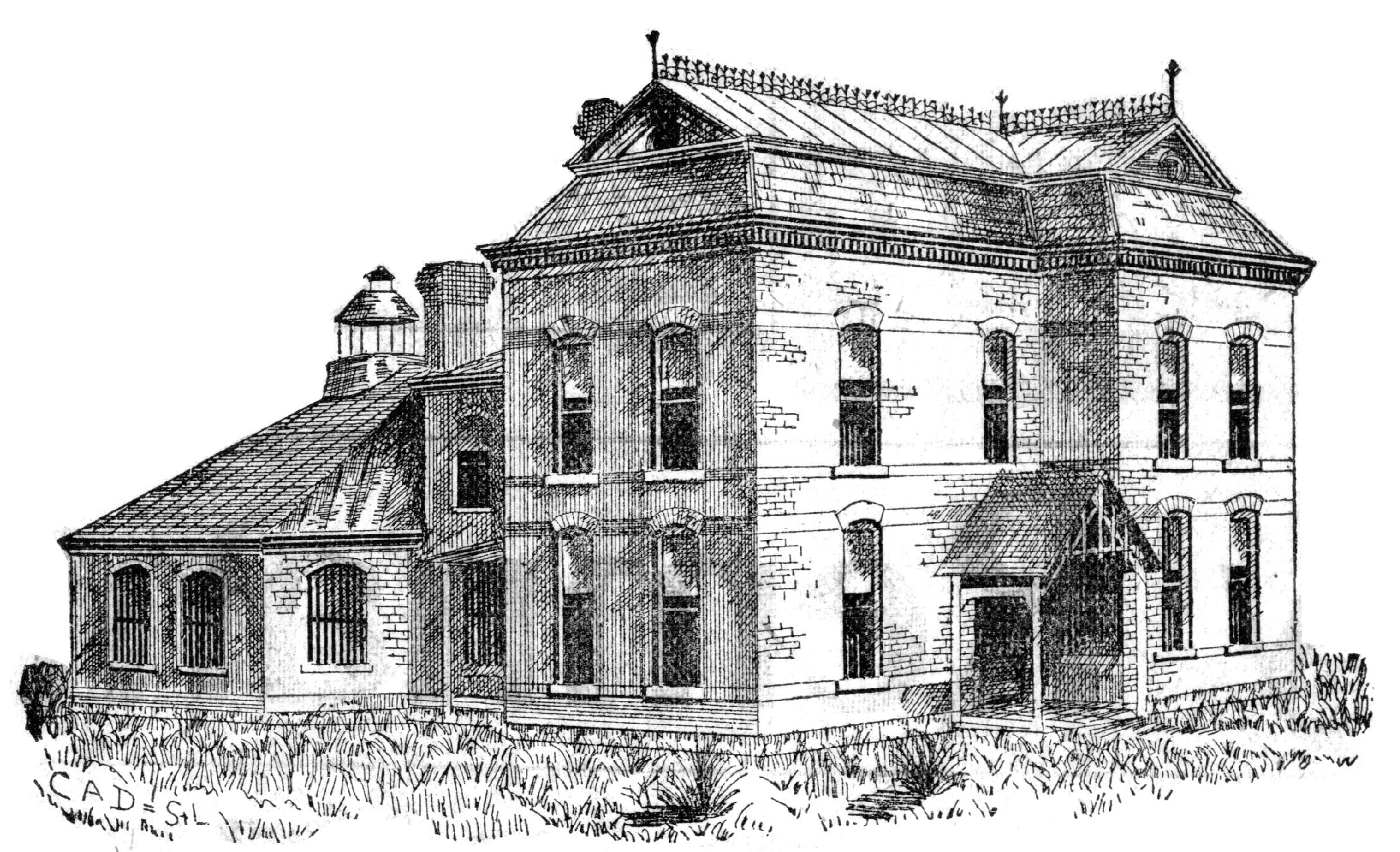
FRANK JAMES AT THE BAR.
This website brought to you in part by the following sponsor:

Find out how to advertise here - Email us! [email protected]
The Trial of the Notorious Bandit Commenced — Opening of the Case by State’s Wallace — Testimony for the Attorney Prosecution. — The Defense — Attempt to Prove an Alibi-Testimony Showing that Frank James was Not at Winston.
GALLATIN, Mo., Aug. 28.
Mrs. Bolton was recalled and testified to particulars relating to the killing of Wood Hite and the disposition of his body.
Elias Ford, recalled, testified to the killing of Wood Hite, stating that Liddell was shot and wounded at the time.
Miss Ida Bolton identified Frank James and testified to seeing him several times at her uncle’s (Charles Ford’s) house, where he was known by the name of Hall and wore side-whiskers. Witness also testified in regard to the death and burial of Wood Hite.
Willie Bolton testified to the same general effect as the foregoing witness.
James Hughes, of Richmond, identified James as the man he had seen at the railroad depot a year ago last fall in company with two others who subsequently hired a ‘bus to take them to the R & L junction.
Joseph Mallory identified the defendant as a man he had seen having a horse shod in Mr. Pott’s blacksmith shop on the Thursday prior to the robbery.
Jonas Potts, proprietor of the blacksmith shop, identified James and testified to different visits made by James to his shop, to the parties accompanying him, and to shoeing his horses. James had given the name of Green Cooper and claimed to be a cattle dealer from Ray County. Witness saw a mare he shod for defendant about a month after the Winston robbery, when he was told she was a kicker and was Jesse James’ mare.
G.W. Whitman identified James and testified to seeing him at Pott’s shop July 14, 1881, when he got a mare shod. ‘Squire Mallory and Mr. Hughes were there at the time.
Mrs. Jonas Potts, wife of the blacksmith, identified the defendant as having been at her house the 18th or 14th of July, 1881, and partaken of breakfast in company with another man.
General Jamin Matchett, of Caldwell County, testified to seeing Frank James at his residence on July 14, 1881, in company with a Mr. Scott, where they fed their horses and had dinner. Defendant gave his name as Willard, and they remarked that they were going to Gallatin. Defendant had side whiskers.
Ezra Saule testified to having seen the defendant on the line of the railroad about a quarter of a mile south of the track, nearly two miles from Winston, between four and six o’clock on the day of the robbery. He pretended to be buying fat cows. Before seeing the man I struck on an old road not traveled for twenty years. There I found a horse hitched. saddled and bridled, and twenty yards from that was another. They were both bays, or rather one was a sorrel with white stocking on her hind legs, and then I saw this man. By and by his partner came up and was much more sociable and communicative than the one first met. Next day I went to the trestle work on the railroad, where I discovered four horses hitched, and then I found another, and here is a little trophy I found [producing a halter strap.] I also saw a halter strap picked up there by another man, which looked as if it had been cut off or broken through. I recognize the defendant as the man I saw that night.
Gallatin, Mo., Aug 29.
At the opening of court to-day George W. McGraw was the first witness called. He testified to having known Liddell for five years, and to the leaving of a wagon at his house by a strange man some time after the Winston robbery.
W.R. McRoberts produced the Richmond express books and testified to the receipt on May 18 of a box weighing forty pounds addressed to J. F. Ford.
Miss Elda Kindig testified to a man resembling Liddell taking dinner at her home, four miles from Winston, the day of the robbery. Mrs. Kindig testified to the same effect.
William Bray and his son, R.A. Bray, testified to defendant and three other men coming to their house two or three weeks before the robbery. The latter witness recognized Liddell as one of the party. Mrs. Bray also identified the defendant.
Mrs. James Frank,, residing eight miles west of Gallatin, testified to a visit by a man resembling defendant to her home two days before the Winston robbery; he had Burnside whiskers.
Frank Wolfinbarger, residing eight miles northwest of Gallatin, testified to defendant and three other men being at his house in the latter part of June, 1881. They stayed all night.
Mrs. Lindsay, sister of the last witness, testified to the same effect, and thought she could not be mistaken as to the identity of Frank James as one of the party.
P. Matthews testified to the loss on the 19th of June, 1881, of a sorrel horse with blazed face and white hind legs, which he recovered about seven weeks later in Ray County.
William M. Roberts testified to finding above mentioned horse about the last of July or first of August and turning it over to Sheriff Timberlake.
Sheriff Timberlake corroborated the preceding witness and testified to the subsequent disposition of the animal. The State here rested its case and the Court adjourned.
Mr. Rush will make the opening for the defense to-morrow, and, as near as can be ascertained the defense will endeavor to show the existence of a conspiracy to fasten the crime on the defendant, and will also show that Frank James was not in the State when the crime was committed.
THE DEFENSE.
GALLATIN, Mo., Aug. 30.
A few minutes after eight o’clock this morning Mr. Rush commenced the opening statement for the defense. The chief point, he claimed, would be that Frank James was not at Winston. It would be contended that the testimony of an accomplice was insufficient to convict unless corroborated as to the main facts. The character of Mrs. Bolton and Liddell, as well as other principal witnesses for the State, would be shown to be such as to render them unworthy of belief.
There would be testimony to contradict that of such men as Jonas Potts and Ezra Soule, and a witness would be produced who was on the train that was robbed. The latter would swear that Frank James was not in the car. It should be shown, too, that there was a conspiracy to prosecute the defendant with Liddell as the chief plotter, and the Fords and Boltons as co-conspirators.
The officers of the law from Kansas City were in this trial actuated by revenge, as they failed to get the reward of $20,000 which would have gone to them if the accused had surrendered at Kansas City.
As to the man the State’s witnesses saw at different places, it would be urged that this was a man who was like Frank James, but who, in fact, was somebody else. The case was one of mistaken identity, and it would be proven where Frank James really was. The defendant’s counsel had been unable to follow the maze of Liddell’s testimony, because their client could not assist them, he being just as ignorant of the details of the Winston robbery as they were.
The first witness called was Sam T. Brosius, who was on the train at the time of the Winston robbery. He testified to seeing the conductor shot and to the appearance of the robbers who entered the car where he was, whom he described as having full beards. He was certain the defendant was not one of them.
Fletcher W. Horn, a Nashville detective, knew B.J. Woodson in Nashville first in 1877; saw him as often as once a week; he always acted as a gentleman and kept good company; saw him last in March, 1881; he wore sandy whiskers, short on the sides and long on the chin; had seen Dick Liddell occasionally, but never saw him and defendant together; knew Jesse James as J.B. Howard; never knew Woodson and Howard were the James brothers; thought he knew Jim Cummings, but did not know the Hites.
Raymond B. Sloan, an attorney of Nashville, knew defendant as B.J. Woodson in Nashville first in the winter of 1876-77; he was living in the old Felix Smith house; last saw him March 26, 1881; be had light sandy whiskers all over his face; was engaged as defendant’s attorney August 8.
Mrs. Elizabeth Montgomery, who resides mile and a half east of Winston, testified that some strange men ate at her house the evening of the Winston robbery; the clock struck seven before they finished; the younger was the taller and light-complexioned, with Burnside whiskers and mustache; one of their horses was a bay, the other a shade lighter; thought defendant was not one of them, not positive.
Miss M. Montgomery, daughter of the preceding witness, corroborated her mother’s statement; did not think defendant was of the men, but wouldn’t say positively; neither of them had a large, blaze-faced, sorrel horse.
John L. Dean testified to a conversation with Jonas Potts, the blacksmith, in which the latter told him he had been to see Frank James, and that he had never seen him before; another occasion two men had drove up to shop whom he said he recognized as the men he had shod horses for before the robbery.
Marion Duncan testified to a conversation with Potts in the winter of 1882-88, when said he had seen Jesse James’ picture in Winston, and he had shod a horse for him; Potts was pretty boozy at the time.
Gus. A. Chapman testified that Potts told him after visiting Gallatin jail that he did know if he had ever seen defendant before, he could not tell.
The defense offered in evidence the record of the trial and conviction of Dick Liddell for horse stealing in Vernon County in 1874, which was read to the jury.
Joseph A. Shelby testified to his acquaintance with the James brothers, Dick Liddell, alias Black, Bill Ryan and Jim Cummings, Jesse and the three latter visited his place 1880, in company with Jesse James, and in conversation which ensued regarding the Concordia Bank robbery Jesse indicated Liddell as the man who struck the cashier; had not seen Frank since 1872. Mrs. Frank James came to Page City in the Spring of 1881 and sent for witness, who went and saw her; she said Liddell and others were committing depredations and her husband was getting the credit for them; she wanted witness to intercede with the Governor, but witness told her it would be folly to do so; did not know what time the sewing machine arrived and did not know where Mrs. James directed it to be shipped to; was only assisting a woman distress; the last time witness saw Jesse James was in the Fall of 1881; Frank James was bleeding at the lungs in 1872 and stopped at witness’ house sixty or eighty days; did not know he was a fugitive from justice.
J.B. Chiles, of Kansas City, testified to conversation with Liddell in which he told witness that Frank James was not at Winston.
Thomas M. Nimms, brother-in-law of defendant, testified to his knowledge of the James brothers; was at Mrs. Samuels’ in the summer of 1831 twice: saw nothing of Frank James and did not hear of his whereabouts; knew Wood Hite; there was a strong resemblance between him and defendant; had not I seen defendant for a number of years till he I visited him in Independence jail; saw Wood Hite in the summer of 1881, but not since.
William Nicholson, another brother-in-law of defendant, had never known defendant until he met him last Thursday. Liddell, the Hites and Jesse James were at witness’ house all through the summer of 1881; never saw Frank with any of them; there was a strong family resemblance between Wood Hite and Frank James.
Robert J. Williams testified that Mrs. Bolton’s and Captain Ford’s reputation for truth and veracity was bad. M.D. Duval, John T. Norval, George W. Trigg, James L. Ferris, A. B. Elliott, John Millstadt and James B.
Duval testified to the same effect, particularly with regard to Ford.
D.D. Woodson said Ford’s reputation was bad, which grew out of the fact that the James gang were rendezvousing at the Ford house.
Gallatin, Mo., Aug. 31.
Shortly after the opening of court this morning General Shelby appeared and proceeded to make an apology for certain irregularities in his conduct the day previous while on the witness stand, and after listening to rebuke from the Court and settling a fine of ten dollars which had been entered up against him, withdrew. The testimony for the defense then proceeded.
James S. Demasters, Justice of the Peace of Richmond, testified that he officiated at the inquest on Wood Hite, and that Mrs. Bolton then testified that she had not seen Frank James for two years.
James C. Mason, a neighbor of the Fords. testified that Captain Ford told him that he did not think Frank James was in the Blue Cut or Winston robberies, as Frank had left the balance of the boys and settled down; had had conversations with Mrs. Ford and old man Ford to the same effect, the latter stating that Frank James was not in the State at the time of the Winston affair.
Ananias Duval testified that old man Ford told him just after Jesse James was killed that he had never seen Frank and did not know when he was in the State.
W.D. Rice, living near Richmond, testified that Willie Bolton was working for him just after the Wood Hite inquest and that Willie of his own motion told him that he had told a story at the Coroner’s inquest and that his mother made him do it.
John T. Samuels, half-brother of Frank James, testified that he last saw Frank before the Winston robbery in the year 1876, when he was at home in Clay County; next saw him at Independence after his surrender; was home all through the summer of 1881; saw Jesse in May, 1881, at home in company with Dick Liddell. He stated that they had come from Kentucky; they arrived at night. After they got there mother asked Jesse where Frank was. He replied he had left Frank in Kentucky, and that Frank was in bad health and was talking of going South. Mother then spoke to Dick Liddell about Frank, and he made about the same response. Jesse remained at home for two or three months off and on; last saw him there about the last of July or the first of August. During these three months I saw Dick Liddell, Clarence and Wood Hite and Charley Ford about the place. There was a striking family resemblance between Wood Hite and Frank James; saw nothing of Frank all that summer.
Mrs. Zerelda Samuels, mother of Frank James, testified that Jesse came home in May, 1881. Dick Liddell was with him. “They said they came from Kentucky, I asked where ‘Buck’ was, that being the name I call Frank. He replied that he had left Frank in Kentucky in bad health. I said ‘Son, you know he’s dead. You may as well tell me first as last,’ I then turned to Liddell and asked him, and he said Frank was alive, but was in Kentucky and was in bad health. During that summer Clarence and Wood Hite and Dick Liddell and Charley Ford were at the house frequently. Frank was not there during that summer, and I did not see him from the time, seven years ago, when Sheriff Broome and others came and shot him, till I saw him after his surrender. Jim Cummings was at the house some time in June of 1881. I did not at that time know where Frank was, but thought he was dead. I am fifty-nine years old, and have six children. I was in my fiftieth year when my arm was shot off and my I little boy was killed.” Being asked whether, when the men left the house after the Winston robbery, they did not take some strange apparel with them, she said: “Yes; I gave them a dress and apron and a bonnet, so that one of the gentlemen could pass off as a lady and you all couldn’t catch ’em.”
Allen Palmer, a brother-in-law of Frank James, testified to returning to his home In Wichita Falls, Texas, about the 1st of August, 1881, and found Frank James there with his family; he wore nothing but a mustache on his face; at that time there was no railroad nearer than Fort Worth, one hundred miles from where he lived; Frank seemed to be kind of ill; said his lungs were affected.
Mrs. S. Palmer, wife of above witness, testified that Frank James was at her home at Wichita Falls, Tex., from June, 1881, to July 1st, and after an absence of about four weeks returned the latter part of July and left finally in September. He talked about surrendering, saying he would like to have some of his friends negotiate with the Governor of Missouri.
Frank James was placed on the stand to testify in his own behalf and gave a detailed account of his movements from the winter of 1876 till his surrender, stating among other things that be was in Texas during the summer of 1881 at the residence of his sister, and heard of the Winston and Blue Cut robberies while on a trip into the Indian Nation and immediately returned to his sister’s feeling sure his name would be connected with it
————-
The Greenville Advocate, September 6, 1883, Page 7. via Newspapers.com (https://www.newspapers.com/article/the-greenville-advocate-1883-greenvill/199957059/ : accessed June 22, 2026), clip page for 1883 – Greenville IL report by user darryl_gpc54