Volunteers, Donations Crucial to Restoring Rotary Jail in Gallatin, MO
Squirrel Cage Jail |
When the decision to restore Gallatin’s rotary jail was announced, the public was asked to help locate any items which could be returned to the jail — especially any section of jail cell bars which once encircled the prisoner cells. Several authentic sections of the heavy iron bars were located in unusual places. For instance, the Missouri Department of Transportation helped reclaim three jail cage sections partially buried under a driveway off MO-13 to protect a ditch culvert. Other sections were found on farm land.
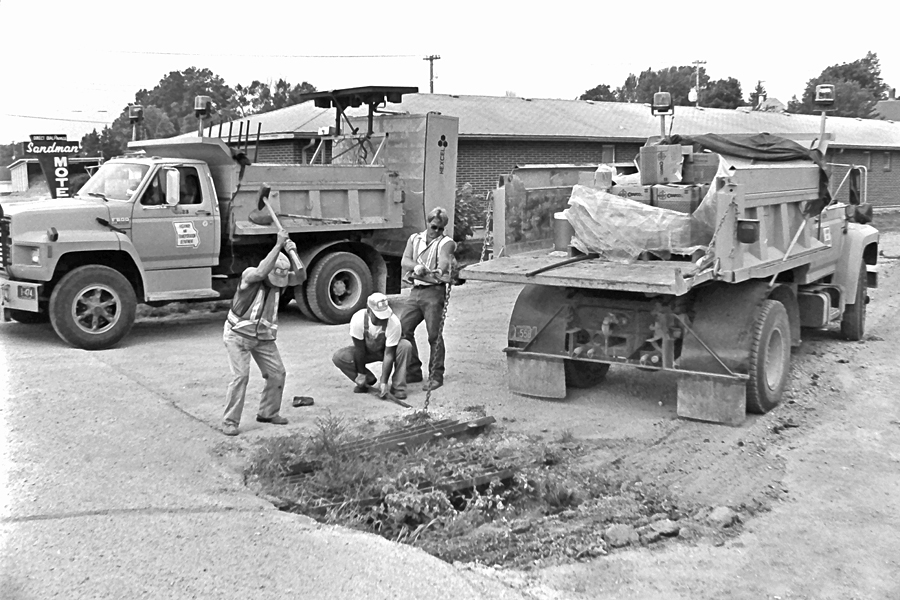
The original curved jail cell panels were hard to find. Here state highway workmen remove concrete to expose and extract the jail panels.
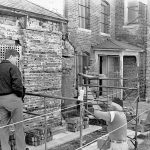
A new roof for the sheriff’s residence and jail was top priority. Then a new brick exterior for the octagon-shaped jail was completed, once it was confirmed that brick replacement would not jeopardize the jail’s standing for inclusion on the National Register of Historic Places. Photos of the work to rebuild the brickworks are shown below:
-
-
The poor condition of the squirrel jail was obvious, both in the exterior and interior of the structure. Many were unwilling to pursue the financial and physical challenge in restoring the architectural antique. Initial inspections were discouraging.
-
-
The poor condition of the squirrel jail was obvious, both in the exterior and interior of the structure. Many were unwilling to pursue the financial and physical challenge in restoring the architectural antique. Initial inspections were discouraging and the damage seemed worse than expected when renovations began.
-
-
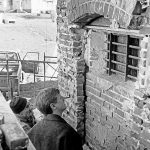
Jail restoration “sorta just happened.” First, a new roof was installed with little intention of what was to come. Years of water damage to exterior brick was caused not only by leaking wooden gutters but by interior iron wall panels holding moisture against the brick. Rebuilding brick walls was necessary to stablize the jail building and proved to be no hindrance when the Daviess County Historical Society sought to list the jail on the National Register of Historic Places.
-
-
Window repair was an immediate concern when brickwork began to restore the squirrel cage jail’s exterior. Original window openings were nearly “bricked up” when the county installed interior iron wall panels surrounding the squirrel cage. It appeared the horizontal window bars were part of these modifications. Later, while inspecting other squirrel cage jails at Council Bluffs (IA) and Crawfordsville (IN) it was discovered that horizontal window bars were part of its original design. Offset horizontal panels allowed a glass window panel on a centered pivot to open or close while keeping inmates incarcerated.
-
-
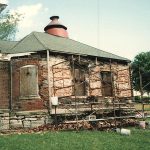
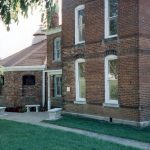
Decay of the jail’s brick exterior was accelerated when an interior metal lining was added while modifying the original squirrel cage area to two large cells. The metal held moisture against the brick for many years, causing the mortar to rot. Thus, during reclamation in 1991, the jail’s exterior brick had to be entirely replaced.
-
-
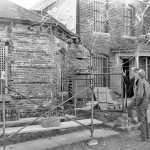
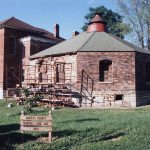
Bricks used to construct the 1889 jail were “soft brick” locally made, commonly used throughout this region. Deterioration due to maintenance neglect caused new brickwork the be necessary to stablize the old jail. Here Dan Lockridge and Wayne Clevenger inspect the jail’s east exterior wall.
-
-
Decay of the jail’s brick exterior was accelerated when an interior metal lining was added while modifying the original squirrel cage area to two large cells. The metal held moisture against the brick for many years, causing the mortar to rot. Thus, during reclamation in 1991, the jail’s exterior brick had to be entirely replaced.
-
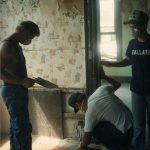
A number of volunteers answered the call for a “Work Day” as shown in these photos below. Many hands helped remove debris to prepare interior rooms of the sheriff’s residence for new drywall and paint.
-

-
Removing interior debris preparing for jail house renovation was a dirty job completed by community volunteers.
-
-
Removing interior debris preparing for jail house renovation was a dirty job completed by community volunteers.
-

-
Removing interior debris preparing for jail house renovation was a dirty job completed by community volunteers.
-
-
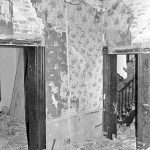
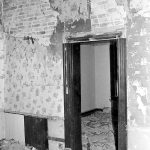
Layers of wallpaper in the sheriff residence kitchen offered evidence of the building’s longevity in actual use. In latter years after the jail no longer housed inmates, the county operated radio dispatching here, offering the residence to whomever was employed as dispatcher.
-
-
The structural integrity of the sheriff’s residence at the jail was obvious when work removing horse hair plastering exposed interior walls three bricks thick. The residence sets on large foundation stones, moved from the former jail on the courthouse yard. There was little evidence of any wall damage or wall drift from its original construction.
-
-
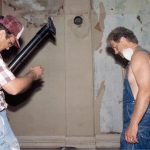
Once word circulated about a work day at the county’s jail, volunteers gathered and put in long hours of labor. Here Larry Richards and Danny Dixon work in a room of the sherriff residence.
-
-
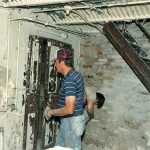
Volunteers worked several days stripping off decayed plaster, paint, wallpaper, and other debris inside the sheriff’s residence and elsewhere throughout the 1889 Squirrel Cage Jail facility. Here Tom Cragg and Darryl Wilkinson work at the rotary jail’s locker dor entry.
-
-
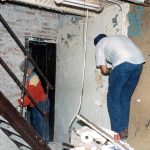
Volunteers worked several days stripping off decayed plaster, paint, wallpaper, and other debris inside the sheriff’s residence and elsewhere throughout the 1889 Squirrel Cage Jail facility. Old electrical wiring was removed for replacement.
-
-
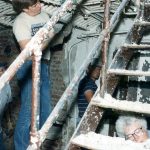
Layers of paint had to be removed on most of the ironworks of the squirrel cage jail. Here volunteers Wayne Clevenger, Darryl Wilkinson, Tom and Nita Cragg work in the entry room of the jail.
-
-
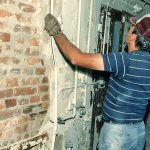
Volunteers worked several days stripping off decayed plaster, paint, wallpaper, and other debris inside the sheriff’s residence and elsewhere throughout the 1889 Squirrel Cage Jail facility. Here Tom Cragg and Darryl Wilkinson work at the rotary jail’s locker dor entry.
-
-
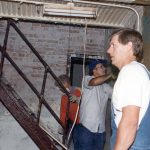
One of the community leaders instrumental in restoring the 1889 Squirrel Cage Jail was Dan Lockridge. Wayne Clevenger and Darryl Wilkinson were also instrumental in efforts.
-
-
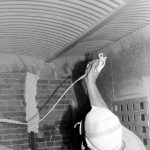
Paint was sprayed on the ceiling at the squirrel cage entrance but no repairs were necessary. Concrete flooring for upstairs hold cells is supported by corregated steel arched between I-beams. Rusting occurred when water pipes were introduced for the holding cells, all a part of the story about the county’s unusual jail building.
-
-
Paint was sprayed on the ceiling at the squirrel cage entrance but no repairs were necessary. Concrete flooring for upstairs hold cells is supported by corregated steel arched between I-beams. Rusting occurred when water pipes were introduced for the holding cells, all a part of the story about the county’s unusual jail building.
-
-
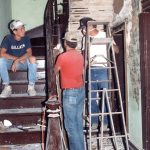
Plaster on lathe walls had to be removed so that new drywall construction could refresh the sheriff’s residence at the jail. Many volunteers carried out the dirty work.
-
-
New electricity wiring was installed while ceilings and walls were exposed at the sheriff’s jail residence before drywall reconstruction was completed.
-
-
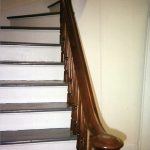
One of the few fine features of the squirrel cage jail intact and in good condition when restoration began was the wooden staircase handrail leading upward from the entrance of the sheriff’s residence.
-
-
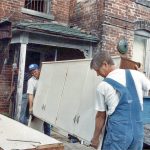
Not everything was kept during rennovations of the squirrel cage jail. Old kitchen cabinets not original to the sheriff’s residence were removed by Wayne Clevenger and Dan Lockridge.
-
-
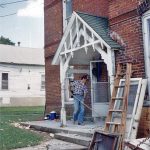
Truckloads of debris were tossed out windows as volunteers provided the labor necessary to complete jail renovations.
-
-
Truckloads of debris were tossed out windows as volunteers provided the labor necessary to complete jail renovations.
While the restoration was underway at the jail property in Gallatin, inmates involved in vo-tech training at Western Missouri Correctional Center in Cameon, MO, fabricated metal parts for a stationary display of the squirrel cage jail using specifications off blueprints of the original rotary jail from the Pauley Company. New jail pieces where made so that the parts could be transported and reassembled inside the jail at Gallatin. Many fabricated parts were welded but the welding was hidden from view in final display since welding, obviously, was not a practice in 1889.
-
-
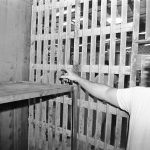
Modern methods were used to refabricate the squirrel cage jail at Western Missouri Correctional Center with much focus details. No welding was visible since riveting iron was the only process used in building the original ironworks in 1889.
-
-
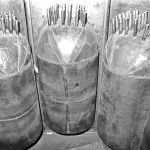
This is a view of jail cell latrines as if you were standing looking outward from the jail’s center axle. Welding and vent pipes are obvious from this side of the refabricated latrines. All ironworks were riveted during the jail’s original construction.
-
-
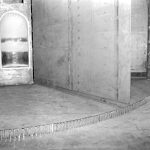
Working from original blueprints, jail parts were fabricated by inmates in vocational school at Western Missouri Correctional Center at Cameron, MO, then transported to the Gallatin jail for reassembly. The end result was a static (non-operational) display of the antique squirrel cage jail design.
-
-
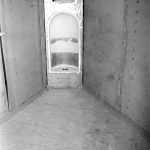
A wall cutaway above a latrine in one of the pie-shaped jail cells enables visitors to look at the center axle upon which the whole apparatus hung.
-
-
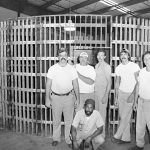
Inmates at Western Missouri Correction Center at Cameron, MO, took on the reconstruction of the jail as a vocational school project, shown here before sections of the original squirrel cage. Inmates provided the labor; Gallatin provided materials. With ironworks completed, the jail was disassembled and transported and reassembled for a static display inside the county jail building at Gallatin.
-
-
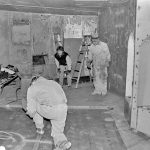
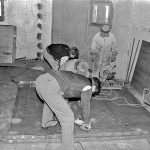
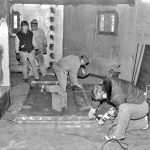
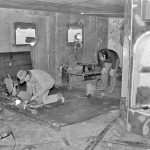
Assembling the refabricated squirrel cage jail cell walls during 1992-93 winter months reminded volunteer how inmates were undeniably exposed to weather temperatures while incarcerated. Sometimes spinning the cage offered a “breeze” during hot summer months but only a single woodburning stove heated the cold steel of the jail.
-
-
Assembling the refabricated squirrel cage jail cell walls during 1992-93 winter months reminded volunteer how inmates were undeniably exposed to weather temperatures while incarcerated. Sometimes spinning the cage offered a “breeze” during hot summer months but only a single woodburning stove heated the cold steel of the jail.
-
-
Assembling the refabricated squirrel cage jail cell walls during 1992-93 winter months reminded volunteer how inmates were undeniably exposed to weather temperatures while incarcerated. Sometimes spinning the cage offered a “breeze” during hot summer months but only a single woodburning stove heated the cold steel of the jail.
-
-
Assembling the refabricated squirrel cage jail cell walls during 1992-93 winter months reminded volunteer how inmates were undeniably exposed to weather temperatures while incarcerated. Sometimes spinning the cage offered a “breeze” during hot summer months but only a single woodburning stove heated the cold steel of the jail.
-
-
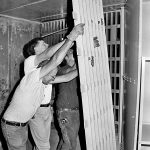
Wayne Clevenger, Dan Lockridge and Eric Kloepping setting original jail bar panels in the rebuilt static display of the squirrel cage jail.
.
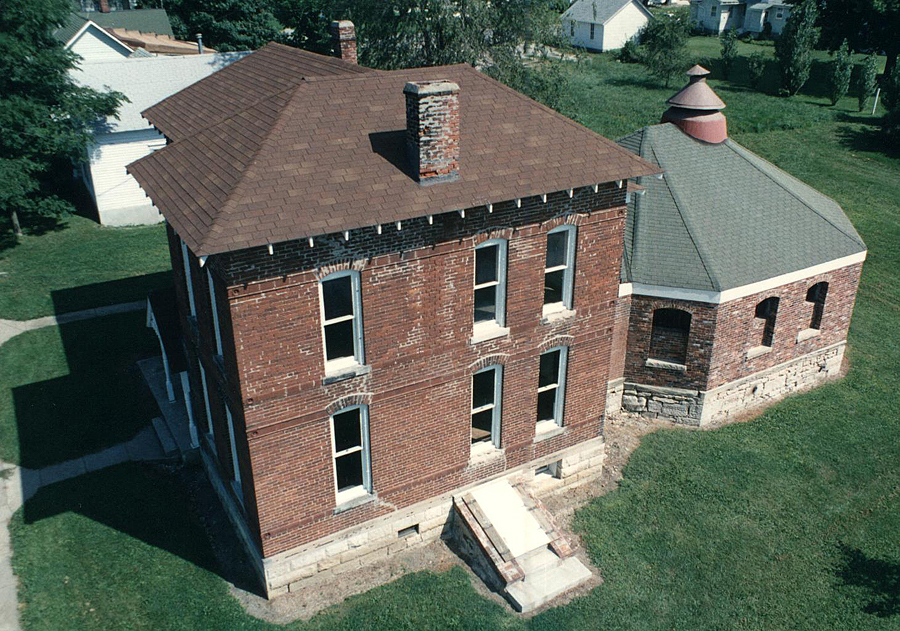
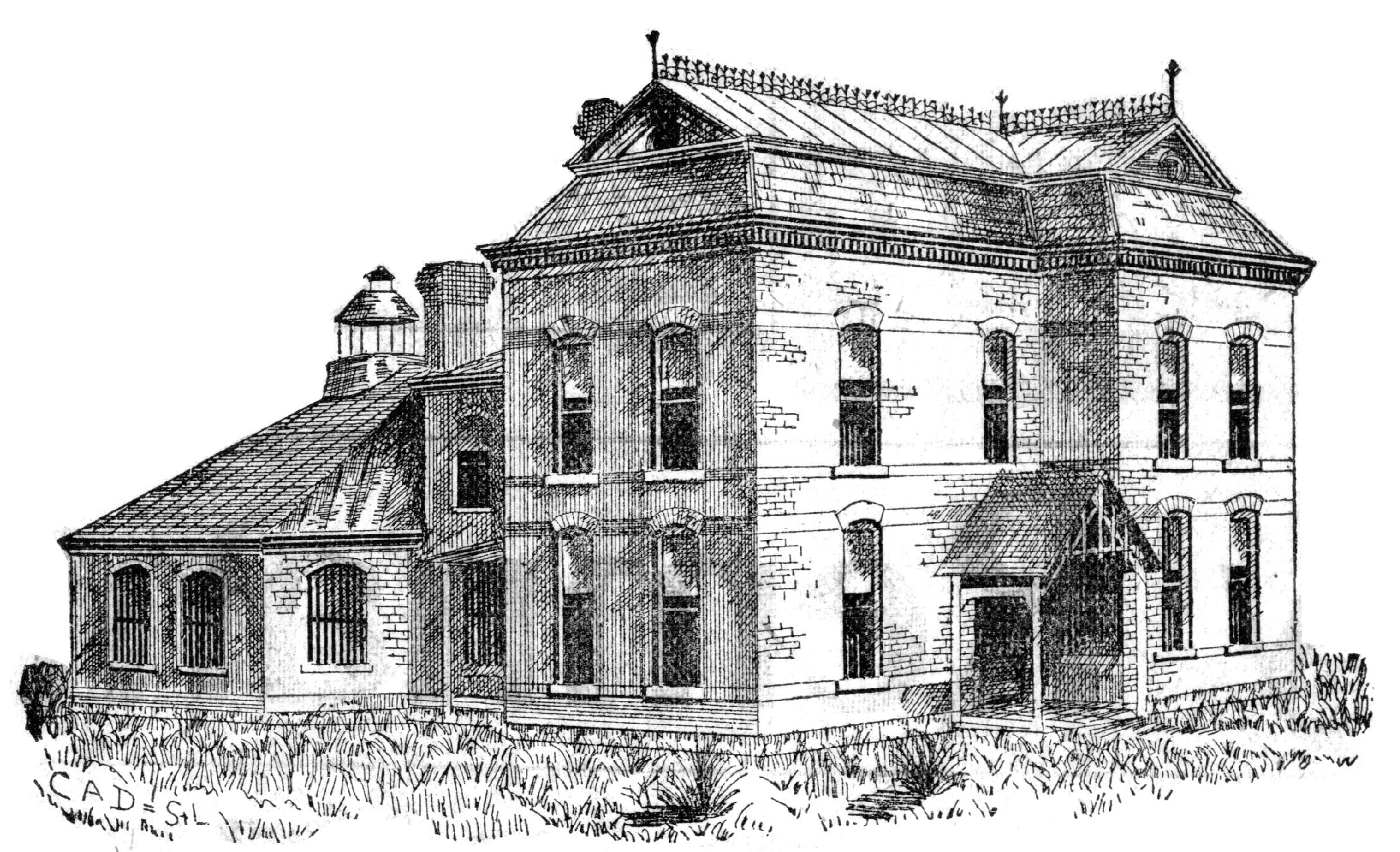
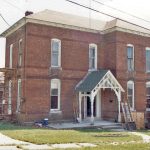
Like any house or building, repairs are endless and more improvements needed to completely restore a structure to its original status. This photo shows the 1889 Squirrel Cage Jail and sheriff’s residence after renovations were completed in 1993. Work then began to design and mount indoor historical displays for those visiting the jail.