
Few Missourians can relate details of what is commonly called the “Mormon War.” Historians mark it as a dark chapter in state annals, when the person of Missouri’s highest official rank ordered the extermination of a group of citizens based on their religious belief.
This website brought to you in part by the following sponsor:

Find out how to advertise here - Email us! [email protected]
Mormon troubles in Missouri can be chronicled in three general time periods: Mormons small in numbers (1831-32 while in Jackson County), Mormons disorganized (1833-35 while in Clay County), and Mormons isolated (while in Caldwell/Daviess counties 1837-38). The last confrontation between non-Mormons and Mormons climaxed at Far West in Caldwell County and ended with Mormon surrender at a “fort” near Adam-ondi-Ahman in Daviess County.
Caldwell and Daviess Counties were created out of Ray County as a legislative act of compromise. The idea was to isolate Mormons from other Missourians while providing some sense of compensation to Mormons squeezed out of their holdings in Jackson and Clay counties. By coincidence, the financial collapse of the Mormon Church at Kirkland, Ohio, prompted a migration of Mormons westward at this same time.
Lyman Wight founded Adam-ondi-Ahman in 1837, which quickly grew to a population of 500. Although Gallatin was the county seat of Daviess County, it was merely a frontier town of a few hundred with few buildings. Within months, Far West swelled to several thousand inhabitants with hundreds of buildings. All indicated similar growth would occur at Adam-ondi-Ahman. Thus, not only did the Mormons’ highly structured and vastly different social and economic community intimidate non-Mormons, but their explosion of growth did as well.

Violence between Missouri homesteaders and Mormons extended beyond legal rights and property damage to physical fighting and murder as depicted in this artist’s sketch.
On July 4, 1838, Sidney Rigdon delivered an address openly stating a Mormon consensus that they would no longer tolerate anti-Mormon actions from outsiders. Outcasts from the faithful plied on this speech and probably exaggerated accounts of Mormon tyranny and aggressiveness. By election day, Aug. 6, a drunken brawl erupted at Gallatin. Two days later, 150 Mormons compelled County Justice of the Peace Adam Black to sign a document guaranteeing Mormon civil rights in Daviess County.

Fighting between Mormons and “Gentiles” erupted at Gallatin, MO, in 1838. Pioneers already living in the area felt threatened by the overwhelming influx of Mormons settling in the area in a very short period of time.
This brawl spawned raids initiated by both belligerent sides throughout this region. In retaliation, the Mormons organized to pillage and burn Millport on Oct. 18. Some accounts claim Gallatin was burned also, though others argue that the Mormons did not cross south of the Grand River. Regardless, the action at Millport was viewed by many as open rebellion against the state. Non-Mormons in Daviess County were quick to call for assistance. On Oct. 25, some 60 Mormons led by David W. Patten fought against non-Mormons at Crooked River in Ray County.
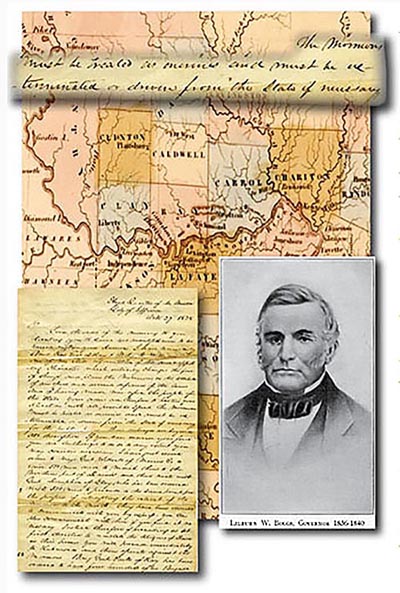
Gov. Lilburn W. Boggs issued an “extermination order” in his attempt to rid Missouri of Mormons.
On Oct. 26, 1838, Gov. Lilburn Boggs called to muster the First, Fourth, Fifth, Sixth and 12th Missouri Divisions of Militia — some 2,200 to 3,000 men — to “exterminate” the Mormon menace from the state. On Oct. 30 some 200 non-Mormons attacked at Haun’s Mill in Caldwell County, killing 17 Mormons. On Nov. 1 the militia converged on Far West, which surrendered.

The political career of Missouri Gov. Lilburn W. Boggs was significantly impacted by the violence between Mormons and Missourians at Haun’s Mill in Livingston County, MO, as depicted in this artist’s sketch.
The following account is taken from an LDS Church History 1836-1844, Vol. 2 (published by RLDS Board of Publications 1897):
“General Clark ordered Brig Gen. Robert Wilson to Adam-ondi-Ahman Nov. 8, 1838. Militia stretched out to confront Mormons in Daviess County south of the Mormon fort. No shots were fired, and surrender occurred at the fort site. Gen. Wilson immediately put guards around Adam-ondi-Ahman and instituted a court of inquiry with Adam Black on the bench and a soldier acting as prosecuting attorney.”
The church account states that all Mormons brought before the inquiry were acquitted. Gen. Wilson ordered all Mormon families out within 10 days but offered permission to winter in Caldwell County, then to leave the state under the extermination order. Orders to execute Mormon leaders were not carried out.
Mormons moved on. Some went to Lamoni, Iowa, some eventually to Nauvoo, IL. Public fervor waned as the legal process stretched out. A trial was set for six Mormon leaders for April 8, 1839, in Daviess County. A change of venue was granted to Boone County. While transferring prisoners there, Daviess County Sheriff William Morgan and four deputies more or less allowed the Mormons to escape without any repercussions from an increasingly disinterested public.
— reprinted from the Gallatin North Missourian, June 9, 1993

Historic sites in North Missouri of interest to the followers of Joseph Smith in the Church of Jesus Christ Latter Day Saints (LDS) — Adam-ondi-Ahman, Far West, Haun’s Mill, Crooked River, Kingston Cemetery, Pioneer Cemetery, Zion’s Camp, Liberty Jail.
>Outcasts from the faithful plied on this speech and probably exaggerated accounts of Mormon tyranny and aggressiveness.
Eliza R. Snow, a Mormon female leader, was gang raped so violently that she lost the ability to have children. Hyrum Smith, a Mormon male leader, testified that he knew a woman who was gang raped by sixteen men who tied her to a bench and so viciously attacked her that it took her three months to physically recover. Missouri militia men killed children.
If anything, people have gone through great efforts to ignore just how horrific the attacks against the Mormons were.
If anything, the church as gone to great lengths to cover the fact that the Mormons literally pillaged and burnt a town.
Not really. It’s actually stated several times in the early church documents with no sugar-coating on the LDS Library app and on their online page.
It just doesn’t get talked about like other things in history, like the Crusades being led by the Catholics, the Japanese Concentration Camps in the USA during WWII, or Japan’s Unit 731 and their inhumane experiments.
Lots of things get scrubbed and sanitized.
Besides, I think the early church followed America’s return-fire policy well.
Japan destroyed two of our boats. We dropped the sun on them twice.
The USA’s “proportional response” to Iran in 1980 for Operation Praying Mantis.