
The Village of Salem was platted in 1856 and the plat was recorded on July 29, 1856. One early history book stated that Salem was laid out by B.H. Coffey in the fall of 1856. One plat shows that the original town consisted of 7 blocks, but other information indicated that the original town consisted of 8 blocks. These blocks, whether 7 or 8, were deeded to the town by John Coffey, a Grantham, and William Galbreath, with the blocks on the north side of Main Street belonging to John Coffey and those blocks on the south side belonging to Grantham and Galbreath.
This website brought to you in part by the following sponsor:

Find out how to advertise here - Email us! [email protected]
Although the town is popularly known as Coffey, is officially listed as Coffey in atlases and elsewhere, and has through the years been known as Coffeysburg and Coffeyburg, the official name today is still Village of Salem and is still platted under that same name. However, throughout most of this Centennial book we will use the familiar name of Coffey.
The first three men to settle in the vicinity of where Coffey now stands were Aurelius Richardson, A.G. Dergin, and Matthew Harbord. The ground on which the Bank of Coffey now stands was given by Wm. Galbreath to Napoleon B. (Pole) Brown and Frederick Westfield, provided they would establish a general merchandise store. The store which Brown and Westfield established was also the first building in town and was locate on the southeast corner of Main and Center Streets. Other “firsts” include the following: Dr. watts, first resident physician and teacher of first school; Edwin McIntyre constructed the first frame dwelling; William Triplett built first blacksmith shop; William Gillispie built first cabinet shop; and the first schoolhouse is said to be the Barr Schoolhouse on Section 12, Range 28, in 1851.
In 1870 the assessed valuation of Coffey was $5,320, and it was the third town in size in Daviess County, MO.
A business directory dated 1877 contains the following names: R.W. Handy & D.W. Handy, General Merchandise; G.M. Walrod, Drugs and Books; A.G. Adams, Shoemaker; Benjamin Phillips and F.L. Read, Drugs; Dillie and McIntyre, Furniture; J.J. Taylor, Harness; Yung & Hendricks, Blacksmiths; William Yarbrough, Rooming House; H.W. Githens, Wagonmaker; Mrs. Martha Evans, Millinery; and J.H. Kellough & N.B. McClung, Physicians.
Other than those named above, the business directory in 1881 included: Smith & Kavanagh; Welden Brothers, Dry Goods and Groceries; Keown & Company, Hardware; H.W. Githens, Wagonmaker; Mrs. Martha Evans, Millinery; and Samuel Griffin, proprietor of Griffin House.
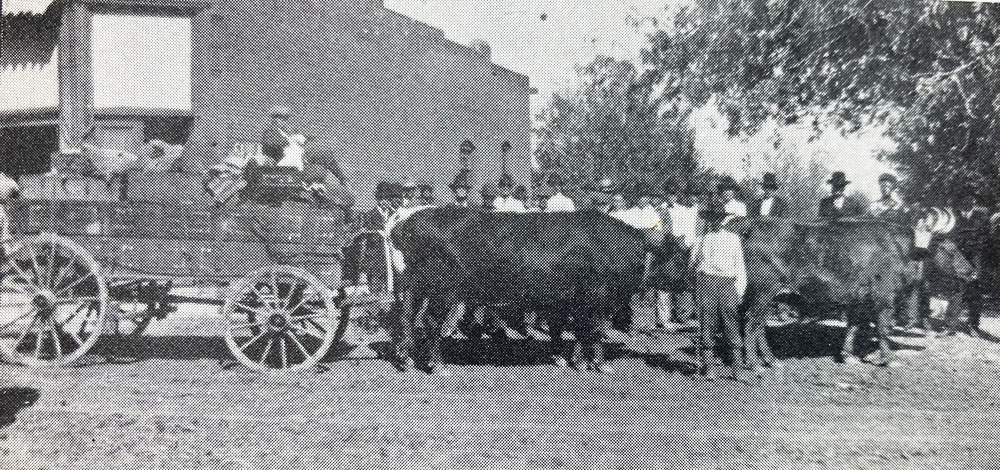
This team of oxen, owned by Francis Taylor, is shown stopping at Coffey, MO, in 1917.
A few random population counts include: 75 in 1880; 349 in 1910; and 367 in 1920. According to an unofficial census taken in April 9, 1956, the population of Coffey was 234. On that date there were 105 occupied residences, 8 unoccupied residences, 20 business establishments, 3 churches, 1 hotel and 2 lodge halls.
In 1956 the value of city real estate was $129,895 and the value of Salem Township outside of the town was $688,020. Total personal property taxes of the township was $209,190. The town board consists of the following men: Nova Holcomb, farmer, chairman; George Wade, clerk; J.W. Carroll, bank clerk; Perry Orten, insurance salesman; Floyd Githens, filling station owner and operator; and Jess Holcomb, retired farmer.
Post Office and Mail Carriers
The name Salem was sent in as the name for the first post office, but the name was refused because of a town by that same name in Dent County. The name Coffeysburg was then decided upon in honor of John Wade Coffey, who owned the original pot of ground of the post office site.
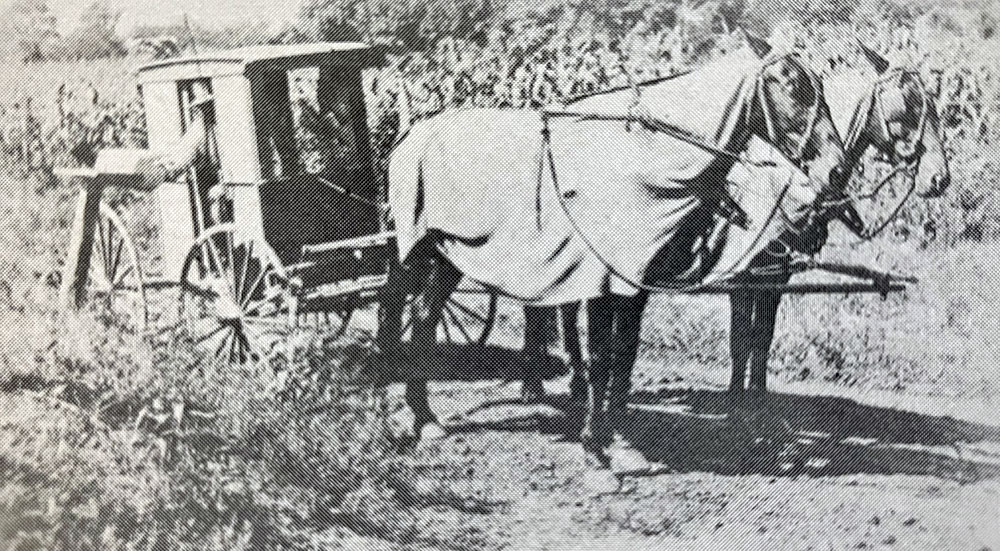
Ike Sturgis delivers the U.S. Mail to a boxholder in the vicinity of Coffey, MO, before the introduction of automobiles.
The first daily mail came to Coffey in 1867 and Professor Walrod was the first postmaster, who served to 1880. Other postmasters include the following: Jesse W. Rupe 1880-83; W.T. Pugh 1884; H.T. Keown 1885; J.R. Cunningham 1886-88; Jesse Rupe 1889-92; R.J. McClary 1892-97; Jesse Rupe 1897-1904; Alonzo Dugger 1905-08; Mrs. J.A. Chambers 1909-40; and Earl Stewart 1940-present (1956).
The post office has been located in several different places, many of which have been torn down. The present post office is located on the north side of Main Street.
There have been only two mail carriers serving the Coffey route, as follows: W.T. Pugh, 1904-23, serving 100 boxes; and Otto H. White, 1923-present (1956), 78 boxes.
Hotels and Rooming Houses
The present hotel is the only hotel ever in Coffey, although there were several rooming and boarding houses. William Yarbrough kept a rooming house in 1877 and Samuel Griffen in 1881. Mrs. lonzo Dugger kept boarders both before and after the railroad came through Coffey.
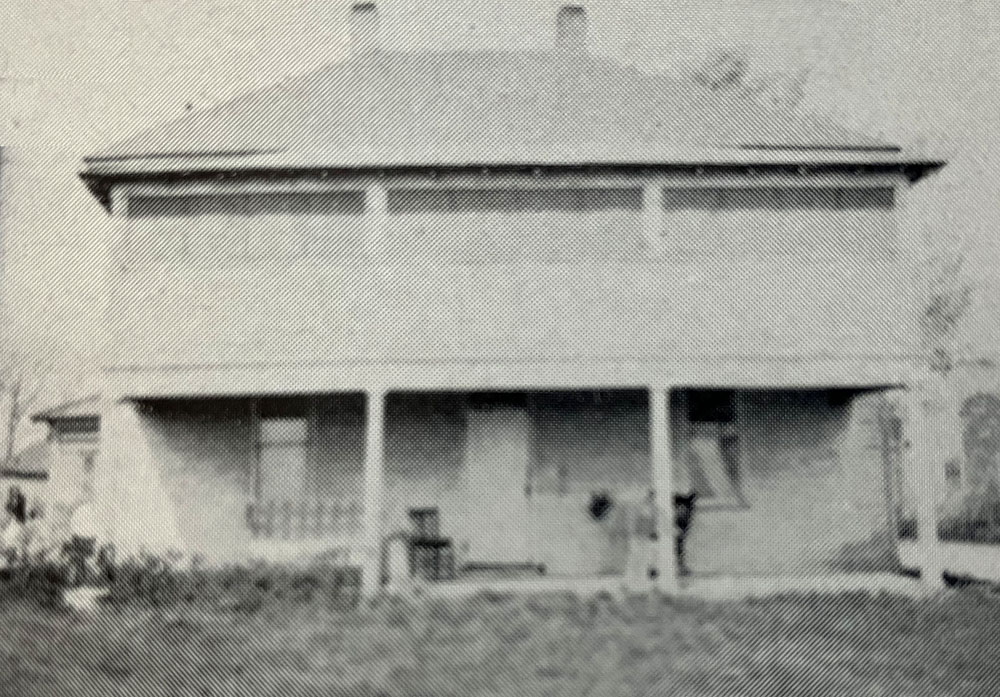
The only hotel in Coffey, MO, was built by Callmore Welden in 1898 with the arrival of the railroad. This photo was taken when operated by Mrs. W. Caraway.
The present hotel was built in 1898 at the time the railroad was constructed. Callmore Welden built the hotel and operated it a few years. Other hotel keepers include Charley Ford, Mr. and Mrs. Alonzo Dugger, George Welch, Elden Davison, Henry House, and Mrs. W. Caraway, who has operated the hotel from 1925 to the present time (1956).
Doctors
Doctors who have practiced in Coffey include the following: Dr. Watts, who was the first physician in Coffey; J.H. Killough, M.B. McClung, O.N. Thompson, F.B. Dorsey, W. R. Fulkerson, T.N. Foster, L.R. Doolin, J.A. Burtch, W. McCoy, Douglas Underwood, Gerald, and P.S. Baumgardner. Coffey has no doctor at it celebrate its Centennial.
Telephone Office
The first telephone system was in the home now occupied by Mr. and Mrs. Arthur McCoy and the operators were Esther and Grace Coffey. The system was owned by Wm. Stovall of Jameson and was called the Stovall Telephone Company.
The Inter-County Telephone Company, managed by Joe M. Roberts, purchased the Coffey exchange on May 1, 1927, from E.O. Turner. Operators who have worked for the Inter-County Telephone Company include Mrs. Cora Pugh 1923-43; Mrs. Louie Clark 1943-45; Mrs. May McClung 1945-present (1956). Other operators who have worked in the Coffey exchange include Mrs. Anna Yarbrough 1911-23, Anna Brown, Blanche and Claude Rupe, Addie Harris, Kate Salmon and Mollie Armstrong.
The present telephone exchange is located in the south end of the Masonic building.
Industries
Years ago cutting and storing ice was a common industry. John Severe settled on Section 20 in 1841 and built a water mill at the Rocky Ford on Cypress Creek, which was the first mill in the township and in this section of the country. Settlers for miles away came to the mill which stood until 1845 when it was washed away by a flood and never rebuilt.

Davy Hampton (standing right of the wagon at extreme left) and men are shown cutting ice at the railroad pond at Coffey, MO.
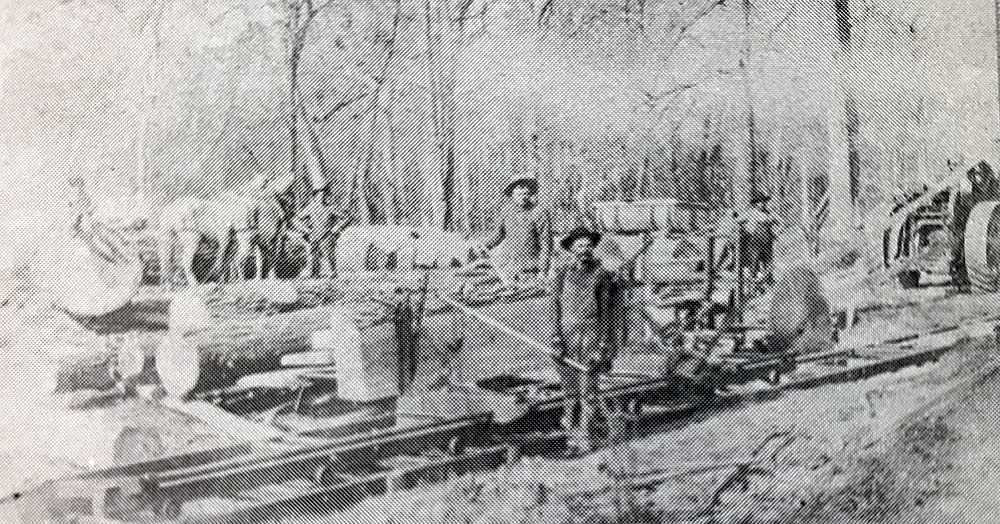
Omer Thompson (on the log) operated a sawmill near Coffey, MO. Ben Youngs is shown in the foreground. (date unknown)
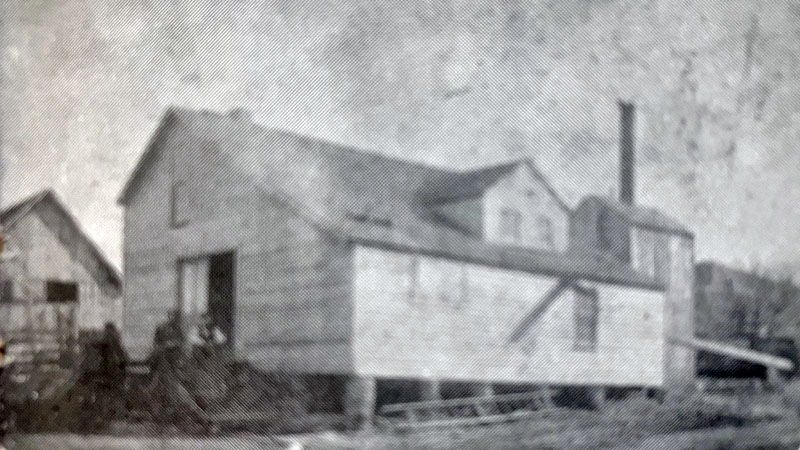
Tom Carter once operated this mill at Coffey, MO (date unknown)
The Mokin Broiler Plant was the last industry in Coffey. The manager was George Phillips. In December, 1954, the plant burned and 17,000 chickens were destroyed. The building was never replaced.
There were probably other industries but no additional information was found by the Centennial book committee.
Entertainment
In 1904 the “Coffey White Caps Baseball Team” organized. Games were played against teams from surrounding towns. The first team was composed of the following men: Charles Miller, catcher; J.E. Robinson, 1st base; James Wion, 2nd base; Les Stewart, 3rd base and pitcher; Cort Hoover, shortstop; Cleve Wright, pitcher; Rolla Sandusky, catcher and center field; Charles Harrington, left field; Percy Pugh, right field and pitcher; Hassett Pugh, utility; Otis Ballard, center field and utility; and Ezra Courter, utility. Others who played later were: Leonard Bergman, Claude Yarbrough, Mack Galbreath, Wm. Underwood, Eugene Alexander, Douglas Underwood, Guy Ballard, and Heslup Courter.
In the years 1935-37 people not only in Daviess County but in other counties as well enjoyed boxing and wrestling matches promoted at the Coffey Athletic Club under the direction of Larry Hunt. The club room below the IOOF Hall wasn’t large enough to accommodate the crowds, but otherwise met requirement. There were no professional matches staged at the club, with amateur fighters only being permitted to enter the ring. So, the fights were for personal advancement in boxing and wrestling circles. There were no “sell outs” for financial benefit, making the fights good, clean and interesting for spectators.
For the past several summers from May to September, free movies are shown outdoors on Saturday nights. These movies are sponsored by the Lions Club and paid for by local businesses.
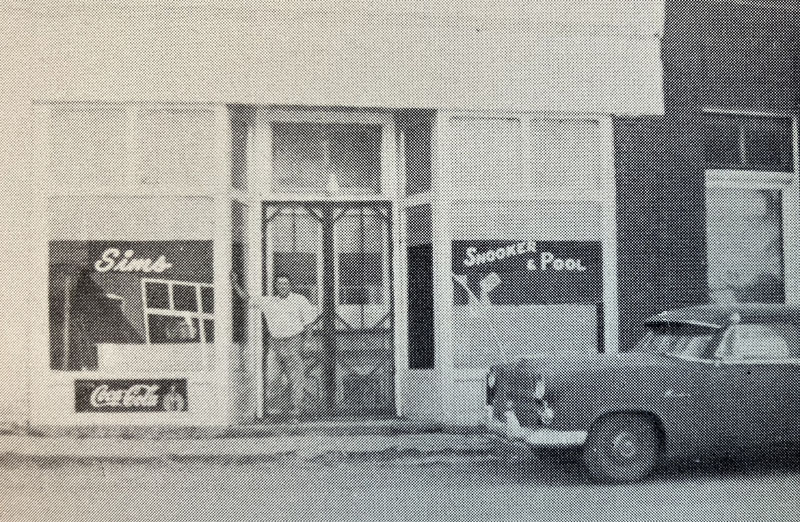
In 1956 Cecil Sims operated a recreational spot on Coffey’s Main Street for his brother, Dan Sims. Patrons played snooker and pool while enjoying soft drinks and beer.
Highways
William Galbreath was one of the committee which secured the crossing of the old state roads at the intersection of Main and Center Streets from Plattsburg to Trenton and Hamilton to Coffey. Since that time improvements in roads have been many.
State Highway 13 was finished as far north as Coffey in 1934 and was completed to Bethany in 1937, thus connecting Gallatin and Bethany on Highways 6 & 69. Originally, Highway 13 was a gravel road but has since been oiled. In 1937 the farm-to-market Route N was built west of Coffey which connected Highway 69 to Coffey. In 1950 Route B was built east of Coffey, making a cross-country road to Highway 6 near Trenton. Plans to oil this road are underway as this book is written.
Coffey is also fortunate in having a highway building, which was constructed in 1954 south of Coffey on Paul Ward’s land. There are several men in Coffey and vicinity employed to operate the equipment housed in this building, all of which aids in maintaining and keeping roads in this vicinity in good repair. Harold Russell, who resides in Coffey, is the foreman of the group working out of Coffey.
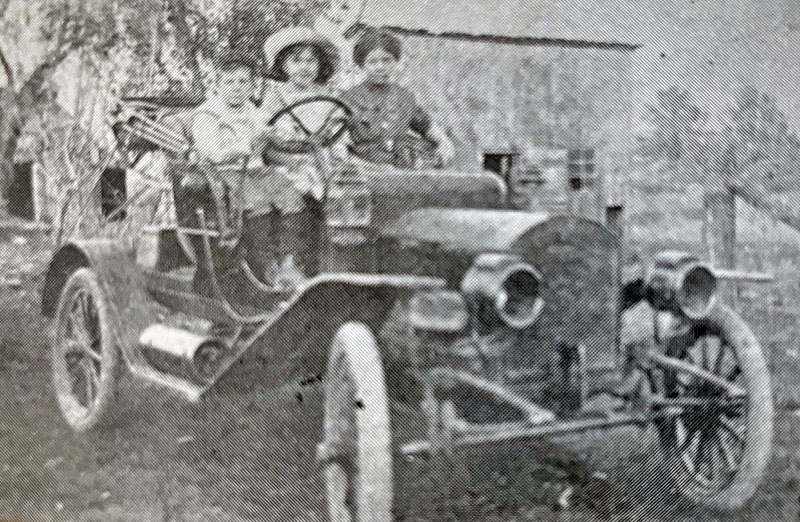
This 1906 Maxwell was owned by William Dowell, the first car owner in the Coffey, MO, area. Shown are Clarence Dowell, Fannie Merritt Feurt, and Mrs. Fred Boyd. Notice that the car’s steering wheel is on the right. Headlights used carbide, which was stored in a tank on the right running board. The lights on the dashboard and taillight used kerosene.
Fires
One of the first and most disastrous fires at Coffey occurred in 1913 when the Bank of Coffey and the building known as the Everly Building were destroyed. The Coffey Locker and Duffy Appliance are now near and on that site. In 1914 Holiness Church, which stood where the present MFA tin building stands, was destroyed by fire and also a restaurant building where the Bank of Coffey now stands. Several other fires have plagued the business district, the latest being Vogel’s Grocery in 1954, and the large broiler plant housed in the Mokin Building in 1955.
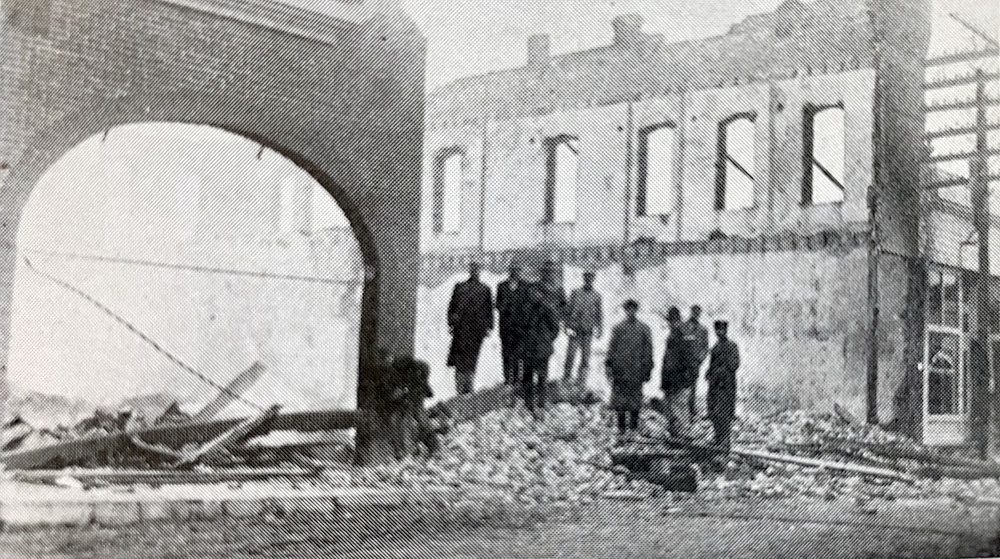
A fire in 1913 destroyed the Bank of Coffey and the Everly Building in Coffey, MO.
Coffey Bands
The Wade Drum and Fife Band organized about 1890. John Wade, father to George, Allen, Milo, Bess, Elvira and Pete, were members of the band. One of the events for which both the Wade Drum and Fife Band and Coffey Band played was when the first train crossed the corporate line and came into Coffey. The last band organized in 1924 and was active until 1927. It was called the McKemey Band with Harvey McKemey as leader.
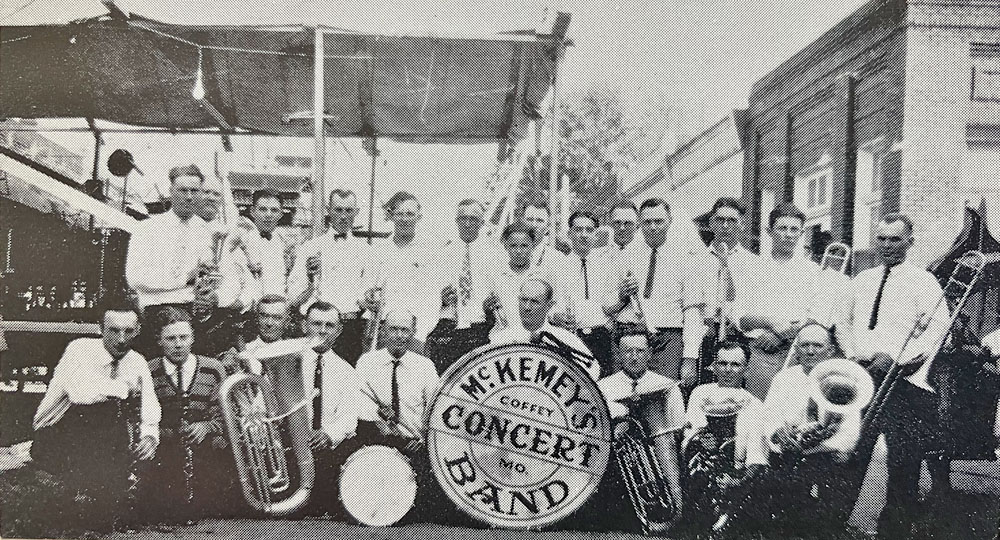
Members of the Coffey Band, front row from left, are Ira Fredricks, Dr. McCoy, Chas. Everly, John Markham, Richard Welden, Harvey McKemey, Douglas Underwood, Theo Miller, Merrill Tolman, Roma Vogel, Charlie Githens, Clyde Bennum, Glenn Knott, Roy Markham; front row — Sparks McClure, Floyd Nighthart, Ed Ennum, Floyd Everhart, Harry Poor, Austin Cunningham, William Underwood, Reed Netherton, and Guy Welden.
Miscellaneous
Twins born in or near Coffey include: Grace and Esther Coffey, Ethel and Edith Henderson Rom and Retha Vogel, Floyd and Loyd Githens, Roy and Loy Mullenax, Faye and Kaye Miller, Connie and Bonnie Stretch, Larry and Sandr Searl, Randall and Sandra Sims, Sheryl Lynn and Carol Ann Scott, Robert Neil and Roger Noel Scott, and Mark and Michael Hutchinson.
Anna McClure at age 87 is the oldest lady in Coffey, born May 5, 1869. John Griffin is the oldest man, 85 years, born May 15, 1871. Sam Myers is 85 years old and has lived in or near Coffey all his life. He was born 1.5 miles north of Coffey on Sept. 28, 1871. The youngest person in Coffey is Eula Ruth Smith, Olin Smith’s daughter, born February 7, 1956.
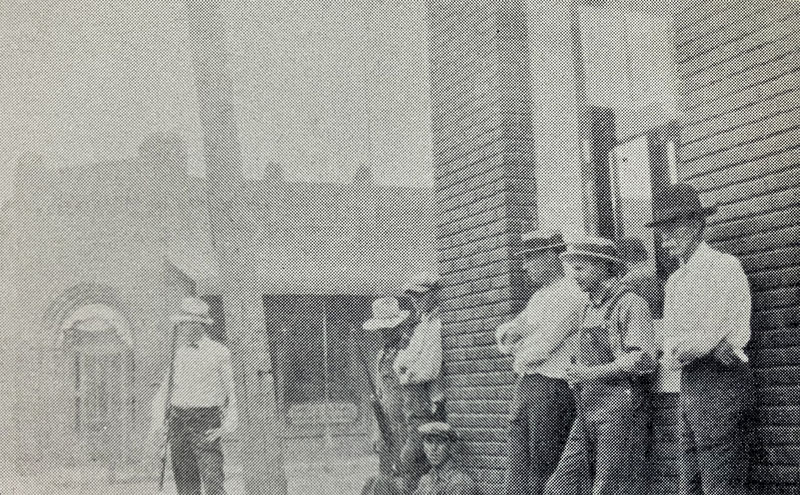
Armed citizens once gathered on Main Street in Coffey, MO, to see that “gypsies” didn’t enter town. Those wary included Sam Parrett, Bob Terry, Bill Creighton, Ralph Railsback, Ross Cole, Mark Conaway and Charles Ford. (date unknown)
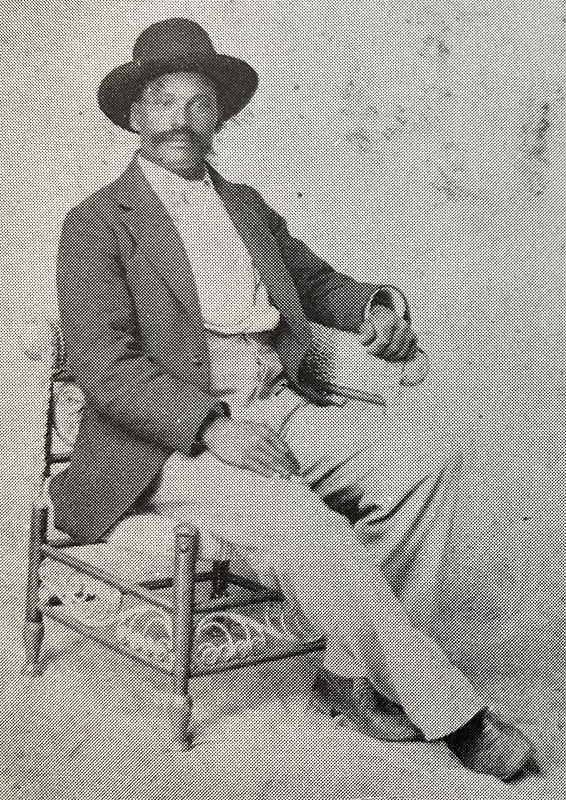
Charles Cowan, who made his home with John R. Welden, was the only African-American to reside in Coffey, MO, according to the Coffey Centennial book. This photo is dated 1896.
Source: Coffey Centennial 1856-1956 book, pages 1-4 & 11; Walsworth Publishing Company
Do you have any picture of Engelhart & Barton Hardware that went out of business about 1913, I think, This is my grandpa. Darrell Barton